
There is a moment in almost every Indian kitchen that visitors from other parts of the world find quietly astonishing. A spoonful of small dark seeds drops into hot oil, and within seconds the entire room changes. A sharp, nutty, almost smoky aroma rises. The seeds crackle and pop like tiny percussion instruments. And the cook, entirely unperturbed, moves on to the next step.
Those seeds are black mustard. And that moment — the tempering, the pop, the transformation — is one of the oldest culinary techniques in the world, documented in Sanskrit texts over five thousand years ago.
But if you are a food manufacturer in Europe sourcing mustard seeds for a condiment line, or a spice blender in the United States building a new pickling range, or an ingredients buyer in Southeast Asia looking to lock in supply for the coming season — the story of mustard seeds is not just ancient. It is immediately, practically relevant. Because the seed you choose, black or yellow, will shape the flavour profile of everything your customer tastes.
And getting it wrong is more common than it should be.
India and the Global Mustard Market: The Numbers First
Before the flavour science, a quick look at why India matters so much to global mustard buyers.
India is among the world’s top producers and exporters of mustard seeds, alongside Canada, Russia, and Nepal. The country’s primary growing belt stretches across Rajasthan, Haryana, Uttar Pradesh, and Madhya Pradesh, with the Rabi season harvest arriving between February and March each year.
Current mandi prices as of March 2026 sit at approximately ₹61–68 per kg at the wholesale level, with export prices ranging from $0.83 to $2.66 per kg depending on variety, grade, and processing level — a range that reflects both market volatility and the significant quality difference between a basic machine-cleaned lot and a premium, sortex-processed, export-specification shipment.
The 2025–2026 season has been broadly positive. Favourable monsoon conditions across the North and Northwest Indian growing belt have supported good soil moisture and healthy crop development, pointing toward a stable-to-firm supply for the year ahead. For buyers who contracted early, this has been a good season. For those who waited, they are entering a market where quality lots are moving quickly.
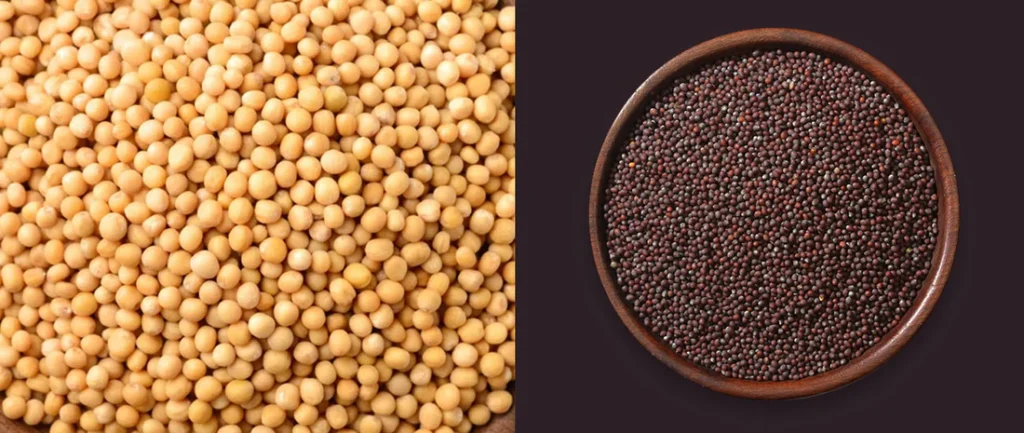
Three Seeds, Not Two: Understanding the Full Picture
Here is something worth establishing clearly before we go further: when people say “mustard seeds,” they are often collapsing three genuinely distinct plants into one category.
Yellow mustard, also called white mustard, comes from the plant Sinapis alba. It is the largest of the three seed types, pale in colour, and the mildest in flavour. This is the seed behind classic American yellow mustard, most European condiments, and much of the world’s commercial pickling industry.
Black mustard comes from Brassica nigra. It is the smallest seed, the darkest, and by a significant margin the most pungent. It has the highest volatile oil content of the three varieties and the most intense, complex aromatic profile. It is the seed that pops and crackles in South Indian tempering, and the one that gives Bengali cuisine its characteristic heat.
Brown mustard, from Brassica juncea, sits between the two. It has a pronounced pungency that outlasts black mustard’s more volatile heat, a richer oil profile than yellow, and is the seed behind most Dijon mustards and many Asian condiment preparations. It is the dominant variety in India’s commercial mustard cultivation.
For food manufacturers, the practical question usually resolves to black versus yellow — brown is better known to most buyers already. So that is where we will focus.
Black Mustard Seeds: What You Are Actually Working With
Black mustard seeds (Brassica nigra) are small, dark brown to almost black in colour, and roughly 1 to 2 millimetres in diameter. Their defining characteristic is pungency — the highest of any mustard variety, produced by a high concentration of allyl isothiocyanate, the volatile compound responsible for mustard’s sharp, heat-in-the-nose quality.
Here is something important that food scientists understand but not all buyers do: raw black mustard seeds are essentially flavourless. The pungency is only released when the seed is crushed or broken in the presence of water, which triggers an enzymatic reaction between the compound sinigrin and the enzyme myrosinase. Heat this process above roughly 40°C, and you deactivate the enzyme. The pungency disappears. Which is why whole black mustard seeds fried in oil — as in South Indian tadka — produce a nutty, mild, almost sweet aroma rather than the fiery heat you might expect.
For food manufacturers, this biochemistry is not trivia. It is a formulation decision.
If your application involves whole seeds going into hot oil or a cooked preparation, black mustard will contribute nuttiness and aroma with controlled heat. If your application involves grinding the seeds with water or an acidic liquid for a condiment or paste, the full pungency releases — and it is intense. Black mustard’s volatile pungency also dissipates relatively quickly due to its high essential oil content, which means products formulated with black mustard need careful packaging and shelf-life consideration.
One more practical note for buyers: black mustard is the only mustard variety that cannot be machine-harvested. It must be handpicked, which makes it more labour-intensive to produce, harder to source at volume, and correspondingly more expensive than yellow or brown.
Black mustard works best for: South Asian cuisine applications, Indian tempering and tadka preparations, artisanal condiments requiring intense aroma, pickling with bold heat, traditional medicine and Ayurvedic product lines, oil extraction for regional cooking markets.
Yellow Mustard Seeds: The Workhorse of Global Food Manufacturing
Yellow mustard seeds (Sinapis alba) are larger, paler, and considerably milder than their black counterpart. Their sinigrin concentration is approximately one-third that of black mustard, which means the pungency they deliver is gentle, approachable, and — critically for commercial applications — consistent and stable.
Where black mustard’s heat lives in the nose and eyes, yellow mustard’s heat sits gently on the tongue. It is a sociable heat, the kind that enhances without demanding attention, that adds depth without alarming. This makes it enormously versatile.
Yellow mustard seeds also have a higher smoke point, a lower volatile oil content (approximately 25% compared to black’s 35–45%), and a longer shelf life in processed forms. These are not just culinary advantages — they are supply chain advantages. A product formulated with yellow mustard seeds is easier to store, easier to transport across temperature-variable routes, and less susceptible to the rancidity risk that higher-oil varieties carry.
Oil content in yellow mustard seeds is lower than black, but yellow mustard is rich in a different compound: para-hydroxybenzyl isothiocyanate, which has documented antimicrobial properties. This is why yellow mustard is used as a natural preservative in commercial pickles, sauces, and fermented products — it actively inhibits the growth of moulds including Aspergillus niger, extending product shelf life without synthetic additives.
Yellow mustard works best for: Classic Western condiments (American mustard, mild Dijon-style preparations), commercial pickle and brine formulations, salad dressings and vinaigrettes, emulsified sauces, bakery glazes, seasoning blends for European and North American markets, clean-label product lines where natural preservation is a selling point.
The Head-to-Head for Manufacturers
Here is a clear comparison across the parameters that matter most in a commercial formulation context:
Botanical name — Black: Brassica nigra. Yellow: Sinapis alba.
Seed size — Black: Small (1–1.5mm). Yellow: Large (1.5–2mm).
Colour — Black: Dark brown to near-black. Yellow: Pale yellow to cream.
Pungency level — Black: Highest of all three mustard varieties. Yellow: Low to moderate, approachable and stable.
Where heat is felt — Black: Nose, eyes, and back of throat — a rising, volatile heat. Yellow: Tongue only — a gentler, surface-level warmth.
Oil content — Black: 35–45%, high volatile oil, strong aroma, faster rancidity risk. Yellow: ~25%, lower volatile oil, milder aroma, more shelf-stable.
Harvesting method — Black: Handpicked only, labour-intensive, limited volume availability. Yellow: Machine-harvestable, consistent supply, scalable procurement.
Pricing — Black: Higher, due to labour cost and limited scale. Yellow: More accessible pricing, better suited to volume production.
Shelf life in processed form — Black: Shorter. Volatile oils degrade with heat, light, and time. Yellow: Longer. More stable across storage and transit conditions.
Primary industrial use — Black: Tempering, oil extraction, artisanal condiments, bold flavour applications. Yellow: Condiments, pickling, emulsifications, natural preservation, everyday seasoning blends.
Quality Parameters Every Manufacturer Should Specify
Regardless of which variety you are sourcing, a professional export supplier should be able to provide documented verification of the following before any purchase order is raised:
Moisture content — Maximum 8–10%. Excess moisture accelerates rancidity in high-oil varieties, particularly black mustard. This is the most frequent cause of quality failure in transit.
Purity level — Minimum 98–99% for standard commercial grades. Specify this clearly. An unspecified “mustard seeds” order can arrive with significant foreign matter and still technically meet a vague contract.
Oil content — For extraction-grade mustard, minimum 38–42%. For culinary and condiment applications, specify the variety and purity rather than oil content specifically.
Volatile oil / allyl isothiocyanate — Relevant particularly for black mustard destined for condiment or paste applications. This determines pungency intensity in your finished product.
Pesticide residue (MRL compliance) — Mandatory for EU, US, and UK markets. Request third-party lab reports from accredited testing facilities, not just supplier declarations.
Moisture-proof, odour-proof packaging — Mustard seeds, especially black, are sensitive to ambient moisture and foreign odour absorption. Packaging specification matters as much as the product specification.
Certificate of Analysis — From an accredited third-party laboratory, covering all of the above parameters plus microbial counts for markets with food safety authority oversight.
Pricing Context for 2026
Current domestic mandi prices in India range from ₹50 to ₹72 per kg, depending on location and variety, with an average of approximately ₹61–68/kg. FOB export prices range broadly:
Standard machine-cleaned mustard (FAQ grade): $0.83–$1.20 per kg FOB India Premium sortex-processed mustard: $1.40–$2.00 per kg FOB India Organic certified mustard: $2.20–$2.66+ per kg FOB India
Black mustard commands a premium over yellow and brown due to its handpicked harvesting requirement and limited availability at commercial volume. If your application specifically requires black mustard, factor this into your procurement planning and consider contracting early — availability windows are tighter than for yellow or brown varieties.
The 2026 season outlook is stable-to-firm. Strong crop conditions from a favourable 2025 monsoon point to good availability, but export inquiries are robust and well-priced lots are being absorbed quickly. Buyers who wait for the market to soften may find themselves competing for the same parcels later in the year.
Why Sourcing from India Makes Sense in 2026
India’s mustard production infrastructure has matured significantly over the past decade. In-house processing facilities, colour-sorting technology, and third-party laboratory testing have brought Indian export quality in line with — and in many cases ahead of — what comparable origins offer.
From a pricing standpoint, Indian mustard consistently offers a meaningful cost advantage over Canadian origin for buyers in Asia, the Middle East, and Africa, where freight differentials further widen the gap. For European buyers, Indian mustard — particularly for yellow and brown varieties with full EU-compliance documentation — represents a genuinely competitive alternative to domestic European supply, especially in years of strong Indian harvest.
What matters most, however, is not the origin on the invoice but the quality management behind it. India has thousands of mustard exporters. The ones worth working with are those with APEDA registration, in-house processing, transparent documentation practices, and a supply relationship philosophy that prioritises your specification over their margin.
A Note from Sadbhaav Spices
At Sadbhaav Spices, we export both black and yellow mustard seeds, processed through our in-house facility in Maharashtra with full documentation — APEDA certification, Certificate of Analysis, phytosanitary certificate, and flexible packaging to your specification.
We work with food manufacturers, condiment brands, oil processors, and spice distributors across the UAE, Europe, Southeast Asia, and North America. When a buyer comes to us with a formulation requirement — whether they need a high-pungency black mustard for a traditional South Asian product line or a stable, clean-label yellow mustard for a European pickle range — our job is to match the seed to the specification, not the other way around.
If you are at the beginning of a sourcing conversation or looking to qualify a second supplier for an existing mustard line, we would be glad to hear from you.
“The difference between a good product and a great one often comes down to an ingredient decision made months before anything went into a jar. Knowing which mustard seed to use — and sourcing it from someone who knows why — is exactly that kind of decision.”
Ready to Source Mustard Seeds from India?
Tell us your variety requirement, destination market, and target volume. We will send you a sample, a COA, and a competitive quote — and we will be honest with you about lead times and availability.
📧 info@sadbhaavspices.com 📞 +91 7397993793 🌐 sadbhaavspices.com/contact