
India’s exports to Russia reached $4.88 billion in FY 2025, representing a strategic diversification opportunity as Indian spice exporters reduce over-dependence on the United States (which absorbs 15-16% of total spice exports) following recent tariff uncertainties. The spice export segment to Russia totaled $105.77 million in 2024, with tea ($74.19M), ginger/turmeric ($6.65M), pepper ($3.75M), and cumin/coriander ($3.24M) forming the core trade basket—yet this represents barely 2.4% of India’s $4.46 billion global spice exports, signaling massive untapped potential. Russia’s geopolitical pivot away from European suppliers, combined with India’s newly operationalized Rupee-Rouble payment settlement mechanism (bypassing dollar transactions) and Special Rupee Vostro Accounts (SRVAs) approved by the RBI, has eliminated the primary banking obstacle that previously constrained bilateral trade.
The World Spices Organisation (WSO) Chairman Ram Kumar Menon explicitly recommends Indian exporters “broaden and explore Russia, Africa, and Southeast Asia to avoid over-dependence on US and China markets”. This guide provides a comprehensive roadmap for Indian spice exporters to penetrate the $150 million+ Russian spice market through detailed analysis of payment mechanisms (Rupee-Rouble settlements, Chinese Yuan alternatives), Russian GOST-R certification requirements (mandatory for food products), product specifications demanded by Russian importers, logistics routes (Nhava Sheva-Vladivostok 22 days, Iran land corridor), and verified Moscow/St. Petersburg importer contacts across the food processing, HoReCa (Hotel/Restaurant/Catering), and retail distribution sectors.
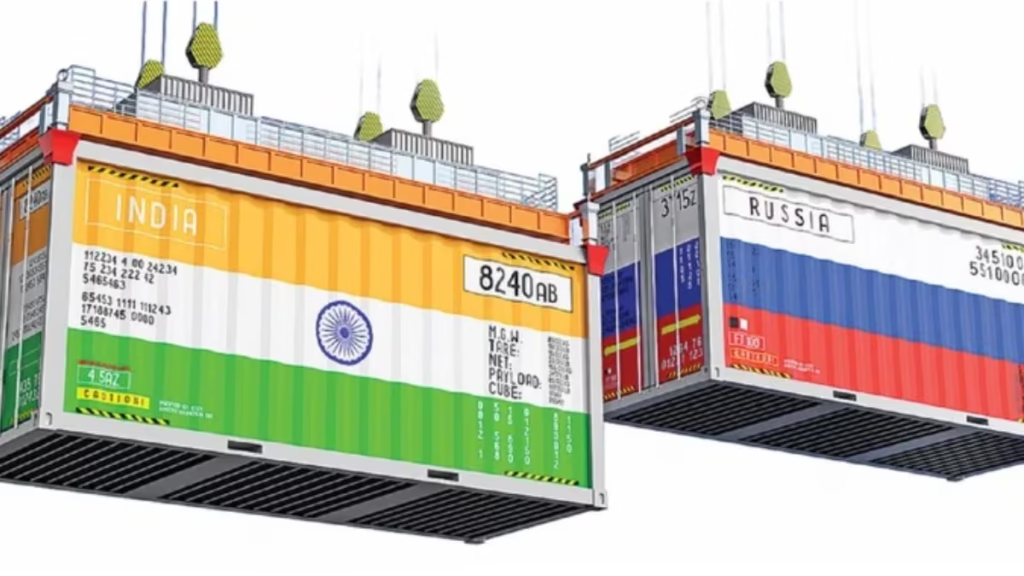
Why Russia Represents Strategic Diversification for Indian Spice Exporters
US Tariff Uncertainty Drives Market Diversification
The United States accounts for 15-16% of India’s total spice exports ($1.4 billion of $4.46 billion), creating concentration risk when tariff policies fluctuate. The WSO Chairman’s November 2025 statement emphasizes urgent need for geographic diversification: “We feel India must broaden and explore other markets like Russia, Africa and Southeast Asia to avoid being over-dependent on one or two markets—US and China—which is the situation now”.
Risk Concentration Analysis:
- USA: 15-16% of total exports ($640-720M spices annually)
- China: 18-20% (primarily cumin, ginger, pepper)
- Combined US-China exposure: 35% of total exports
- Diversification urgency: Tariff changes can impact 35% of revenue overnight
Russia Opportunity:
- Current baseline: $105.77M spice exports (2024)
- Realistic 3-year target: $200-250M (doubling current levels)
- Untapped potential: Russia imports $400-500M spices globally; India captures only 21-26%
Post-Sanctions Supply Vacuum in the Russian Market
European Union sanctions since 2022 have disrupted Russia’s traditional spice supply chains from the Netherlands (Rotterdam re-export hub), Germany, and Poland, creating immediate import substitution demand:
Supply Shift Impact:
- Pre-2022: Russia imported 60% of processed spices via EU intermediaries
- Post-sanctions: EU trade dropped 70-80%, creating $200-300M supply gap
- New suppliers: India, Turkey, Iran, China, competing to fill the vacuum
- India’s advantage: Established diplomatic relations, no sanctions participation, competitive pricing
India has identified 300 products with high export potential to Russia, including significant spice categories where “India’s export capabilities align with Russia’s import demand across key sectors”. Across these 300 products, India currently exports just $1.7 billion to Russia while Russia’s global imports of these same products total $8.2 billion, representing a $6.5 billion untapped opportunity.
Cross-Border E-Commerce & FMCG Growth
“Cross-border e-commerce is driving import substitution, with India emerging as one of the top three non-Chinese suppliers of FMCGs and spices to the Russian market,” according to Artem Sokolov, President of AKIT (Association of Internet Trade Companies) in Russia. Russian online marketplaces like Ozon, Wildberries, and Yandex Market now facilitate direct Indian spice sales to Russian consumers, bypassing traditional importer networks.
E-Commerce Opportunity:
- Ozon marketplace: 35 million active users, spice category growing 40% annually
- Wildberries: Russia’s largest online retailer, ethnic food segment expansion
- MOQ advantage: 100-500 kg lots (vs 10-20 MT traditional bulk)
- Margin premium: 30-50% higher than bulk B2B due to retail pricing
Breakthrough: Rupee-Rouble Payment Settlement Mechanism
Special Rupee Vostro Accounts (SRVAs) Operational
The Reserve Bank of India cleared the path for faster India-Russia payments through revised Special Rupee Vostro Account (SRVA) guidelines in August 2025, eliminating the primary banking bottleneck:
How SRVAs Work:
- Definition: An Indian bank maintains an account in Indian Rupees for a Russian bank (vostro account)
- Previous system: Banks needed RBI permission to open SRVAs, slowing trade settlements by 30-45 days
- New guidelines (Aug 2025): Banks can open SRVAs independently, streamlining invoicing, payments, and settlements
- Trade settlement: 90% of India-Russia trade now settled in national currencies (Rupee/Rouble)
Benefits for Spice Exporters:
- No dollar dependency: Eliminates currency conversion costs (saves 2-3% of invoice value)
- Reduced exchange risk: No exposure to USD/INR volatility
- Faster payments: 15-20 days vs 45-60 days for dollar LC settlements
- Lower banking charges: 0.5-0.75% vs 1.25-1.5% for USD LC
Rupee-Rouble Exchange Mechanism
India and Russia are developing a dynamic rupee-rouble exchange mechanism to avoid costly dollar conversions:
Current Process:
- Indian exporter invoices Russian buyer in INR (₹50 lakh for turmeric shipment)
- Russian buyer’s bank converts Roubles → Rupees at agreed exchange rate
- Rupees credited to the Indian exporter’s account via SRVA within 15 days
- No SWIFT dependency (alternative financial messaging networks operational)
Exchange Rate Mechanism:
- Benchmark: RBI-Central Bank of Russia agreed reference rate (updated weekly)
- Spread: ±2-3% around reference rate depending on transaction size
- Transparency: Published rates eliminate arbitrary pricing by intermediary banks
Challenge & Mitigation:
- Rupee accumulation: Russia accumulates INR due to oil-driven trade deficit ($63.84B imports from Russia vs $4.88B exports)
- Solution: Russian entities can invest surplus rupees in Indian government securities, bonds, equity, infrastructure projects, or use for third-country exports
Alternative: Chinese Yuan Settlement (Tri-Lateral Mechanism)
For exporters concerned about Rouble volatility (20-25% annual fluctuation), Chinese Yuan (CNY) settlement via UAE provides stability:
Yuan Payment Process:
- Indian exporter invoices in CNY (¥350,000 for cumin shipment)
- Russian buyer pays in CNY (Russia holds significant Yuan reserves)
- Indian exporter receives CNY in their bank (ICICI, SBI offer CNY accounts)
- Conversion: CNY → INR at stable exchange rate (±3-5% annual volatility vs ±20% Rouble)
Tri-Lateral Settlement via UAE:
- Russia pays in UAE Dirham (AED) → UAE intermediary converts to INR
- Used extensively in oil trade: “India pays for Russian oil in currencies of countries that have friendly relations with Moscow, such as the UAE Dirham”
- Banking hub: Dubai facilitates 25-30% of India-Russia trade payments
Linking National Payment Systems (UPI-SBP)
Russia’s SBP (Faster Payment System) will link with India’s UPI (Unified Payments Interface) during high-level bilateral discussions, enabling QR code and e-wallet payments:
Payment System Integration:
- Russian Mir card + Indian RuPay card interoperability
- Benefit: QR code payments eliminate need for credit/debit cards
- Cost savings: Reduce commissions on currency exchange by up to 30%
- Use case: Small e-commerce transactions, trade show payments, sample shipments
Russian GOST-R Certification: Mandatory Compliance for Spice Exports
What is GOST-R Certification?
GOST-R certification is a mandatory conformity assessment for products sold in Russia, proving compliance with Russian national standards (GOST – Gosstandard) for safety and quality:
GOST-R Overview:
- Full name: GOST-R (GOST stands for “State Standard”, R for Russia)
- Authority: Federal Agency for Technical Regulation and Metrology (Rosstandart)
- Purpose: Attests that product conforms to Russian national standards for safety, quality, hygiene
- Mark: Products bear official “Certified in Russia” mark widely recognized by businesses and consumers
Mandatory GOST-R Categories for Spices:
- Food products (all spices and seasonings)
- Packaging materials in direct food contact
- Industrial food processing equipment (if exporting machinery)
- Medical-grade spice extracts (pharmaceutical applications)
GOST-R Certification Process for Indian Spice Exporters
Step 1: Product Classification (Week 1)
- Determine specific GOST standard applicable to your spice product
- Common standards: GOST 29050 (cumin), GOST 29049 (turmeric), GOST R 52177 (black pepper)
- Consult with Russian certification body or Indian consultants specializing in GOST-R
Step 2: Application Submission (Week 2-3)
- Submit application to accredited Russian certification body (can be done from India)
- Required documents:
- Technical specification sheet (moisture, purity, microbial limits)
- Manufacturing process description
- Indian certifications (FSSAI, APEDA, ISO 22000 if available)
- Product samples (500g-1kg) shipped to Russian testing lab
- Application fee: ₹40,000-60,000 depending on product category
Step 3: Testing & Inspection (Week 4-8)
- Russian lab conducts testing to verify GOST-R standard compliance:
- Physical parameters: Moisture, volatile oil content, color, size
- Chemical parameters: Heavy metals (lead, cadmium, mercury), pesticide residues
- Microbiological parameters: Total plate count, E. coli, Salmonella, molds/yeasts
- Organoleptic: Taste, aroma, appearance evaluation
- Testing cost: ₹80,000-1.2 lakh per product category
- Factory inspection (optional): Russian auditor may visit Indian facility (₹2-3 lakh including travel)
Step 4: Certificate Issuance (Week 9-12)
- Upon approval, GOST-R certificate issued valid for 1-3 years (depending on product risk category)
- Certificate includes:
- Product name and specifications
- Manufacturer details (Indian company name, address)
- Applicable GOST standard number
- Certificate validity period
- Right to use “Certified in Russia” logo on packaging
Total Investment:
- Initial certification: ₹1.8-2.5 lakh per product category
- Annual renewal: ₹60,000-80,000 (simplified testing if no formulation changes)
- Timeline: 12-16 weeks first-time certification
- Validity: 1 year (food products), 3 years (non-perishables)
Working with Certification Bodies:
Indian consultants offering GOST-R services in India:
- IAS Certification (Pan-India presence)
- SGS India (Moscow office coordination)
- TUV SUD India (Russian standards expertise)
- IndiaMART listed consultants (verification required)
GOST-R vs FDA/EU Certification Comparison
| Parameter | GOST-R (Russia) | FDA (USA) | EU (EEC 834/2007) |
|---|---|---|---|
| Mandatory Status | Yes for food products | Registration (not certification) | Yes for organic |
| Testing Focus | Microbiological + Heavy metals | Microbiological + Pesticides | Pesticides (MRL 0.01ppm) |
| Certification Cost | ₹1.8-2.5L first-time | ₹3-5L compliance | ₹5-8L organic cert |
| Processing Time | 12-16 weeks | Facility registration 2-4 weeks | 45-60 days |
| Validity | 1-3 years renewable | Biennial renewal | 1 year (annual audit) |
| Language | Russian + English accepted | English | Local language + English |
| Factory Inspection | Optional (sample-based) | Not required for registration | Mandatory annually |
Key Difference: GOST-R requires product-specific certification (cumin certificate separate from turmeric), whereas FDA requires facility registration covering all products manufactured there. This makes GOST-R more expensive initially but allows phased product entry (start with 1-2 spices, add more later).
Spices in Demand: Russian Market Product Analysis
Current Import Breakdown (2024 Data)
India’s spice exports to Russia totaled $105.77 million across these categories:
| Product Category | 2024 Value | % Share | Growth Potential |
|---|---|---|---|
| Tea | $74.19M | 70.1% | Saturated (focus on spices) |
| Coffee & substitutes | $17.76M | 16.8% | Growing |
| Ginger, turmeric, thyme, bay leaves | $6.65M | 6.3% | HIGH (3x potential) |
| Pepper (black/capsicum/pimenta) | $3.75M | 3.5% | HIGH (4x potential) |
| Cumin, coriander, anise, fennel | $3.24M | 3.1% | MEDIUM (2x potential) |
| Cardamom, nutmeg, mace | $153K | 0.14% | EMERGING |
| Cinnamon, cloves | $28.5K | 0.03% | UNTAPPED |
Analysis: Tea dominates current exports, but spice categories (excluding tea) totaled only $31.6 million, representing massive growth opportunity given Russia’s $400-500M total spice imports from all sources.
1. Black Pepper: $3.75M Current, $20M Potential
Russian Market Demand:
- Current imports: $15-20M annually from all sources (Vietnam 40%, India 19%, Brazil 15%)
- India’s opportunity: Vietnam sanctions risk creates India preference
- End-use: HoReCa (hotels/restaurants), meat processing, sausage manufacturing (Russia’s large meat industry)
Product Specifications:
- Grade: TGSEB 500gl+ (bulk density indicator), machine-cleaned
- Purity: 98-99% minimum (stone/foreign matter <1%)
- Moisture: <12% (Russian climate requires lower moisture to prevent mold)
- Microbial: Total plate count <100,000 cfu/g (less strict than EU)
- Sterilization: Steam sterilization preferred but not mandatory (unlike EU)
- Packaging: 25kg triple-layer PP bags with Russian labeling (GOST-R compliant)
FOB Pricing:
- Indian FOB (Kochi/Nhava Sheva): $6.80-7.50/kg
- CIF Vladivostok: $8.20-9.00/kg (includes freight $1,200-1,400 per container)
- Russian retail: 1,200-1,500 Roubles/kg ($13-16/kg) – healthy margin for importers
Competitive Advantage:
- India’s Kerala pepper: Superior piperine content (5-9% vs Vietnam 4-6%)
- Aroma quality: Essential oil content 2.5-3.5% (Russian chefs prefer strong aroma)
- Consistent supply: Vietnam crop failures 2023-24 created reliability concerns
2. Turmeric: $6.65M Current (grouped), $25M Potential
Russian Market Demand:
- Current imports: $18-22M annually (India 30%, Iran 25%, Turkey 20%, China 15%)
- Growth drivers: Health/wellness trend post-COVID, curcumin supplements, ethnic food (Indian/Asian restaurants)
- Pharmaceutical segment: Curcumin extract demand for anti-inflammatory applications
Product Specifications:
- Form: Finger turmeric (whole rhizomes) preferred for B2B, powder for retail
- Curcumin content: 3-5% minimum (HPLC tested), pharmaceutical buyers want 6-8%
- Color: Bright yellow-orange (visual quality indicator for Russian buyers)
- Moisture: <10% (preferably <8% for cold Russian winters)
- Microbial: Salmonella absent/25g, TPC <50,000 cfu/g
- Packaging: 50kg jute bags with PE liner (bulk), 100g-1kg retail pouches (e-commerce)
FOB Pricing:
- Standard turmeric (3-4% curcumin): $3.20-3.80/kg FOB India
- Premium Erode grade (6-7% curcumin): $5.50-6.50/kg FOB
- Organic certified (NPOP): $7.00-8.50/kg FOB (emerging Russian organic market)
Market Segmentation:
- HoReCa (40% demand): Indian/Georgian restaurants (Russia has 500+ Indian restaurants)
- Retail (35% demand): Health food stores, ethnic supermarkets (Moscow/St. Petersburg)
- Pharma (15% demand): Curcumin extract manufacturers
- Food processing (10%): Curry powder, ready-meal manufacturers
Opportunity: Russia currently imports $18-22M turmeric but demand is growing at 18-20% annually due to wellness trends. India’s current $6.65M represents only 30-37% market share—doubling share to 60% (realistic given quality advantage) = $12-15M exports.
3. Cumin Seeds: $3.24M Current (grouped), $15M Potential
Russian Market Demand:
- Current imports: $12-15M annually (India 22%, Turkey 35%, Iran 25%, Syria 10%)
- End-use: Ethnic cuisine (Central Asian, Middle Eastern communities in Russia), bread/bakery, meat processing
- Russian demographic: 15-20 million Muslims (Tatarstan, Chechnya, Dagestan) drive cumin demand
Product Specifications:
- Origin: Unjha Gujarat cumin premium acceptance (3.5-4% volatile oil)
- Purity: 99-99.5% (Sortex cleaned preferred)
- Volatile oil: Minimum 2.5% (Russian standard), premium buyers want 3.5%+
- Moisture: <8% (winter storage concerns)
- Color: Greenish-brown natural (no artificial enhancement)
- Packaging: 25kg PP bags, 50kg jute bags, or 100g-500g retail pouches
FOB Pricing:
- Standard cumin (99% purity): $3.20-3.60/kg FOB Mundra
- Premium Unjha (99.5%, 3.5% oil): $3.80-4.20/kg FOB
- Organic certified: $4.80-5.50/kg FOB
Competitive Landscape:
- Turkey dominance: 35% share due to geographic proximity (4-5 days land route vs India 20+ days ocean)
- India’s edge: Price (20-25% cheaper than Turkish cumin), quality (volatile oil content), sanctions risk on Turkey-Russia relations
- Market entry strategy: Target Moscow/St. Petersburg first (established Indian spice importer networks), then expand to regional cities (Kazan, Yekaterinburg)
4. Cardamom: $153K Current, $5M Potential
Untapped Opportunity:
- Russia’s total imports: $4-5M annually (Guatemala 60%, India 8%, Sri Lanka 15%)
- India’s current share: Only $153K (3-4% market share)
- Growth driver: Premium coffee culture (cardamom-infused coffee trend), Nordic/Scandinavian expat community
Product Specifications:
- Grade: 8mm bold green cardamom (premium), 7mm small (standard)
- Moisture: <10% (essential for Russian climate)
- Color: Bright green (visual quality indicator)
- Volatile oil: 3-8% (aroma intensity)
- Packaging: 10kg cartons (for HoReCa), 50g-100g retail jars
FOB Pricing:
- 8mm bold: $38-42/kg FOB (high-value, lower volume)
- 7mm small: $30-34/kg FOB
- Opportunity: Russia pays premium for quality; India can compete with Guatemala on freshness (shorter transit vs Central America)
5. Ginger: Included in $6.65M Category, Emerging Segment
Market Potential:
- Fresh ginger: Growing demand in Moscow/St. Petersburg supermarkets (wellness trend)
- Dried ginger: Food processing, beverage industry (ginger tea, kombucha flavoring)
- Current: Bundled with turmeric/thyme in trade data, estimated $1.5-2M
Specifications:
- Fresh: Young ginger (Kerala/Himachal Pradesh), moisture 80-85%, fiber content <3%
- Dried: Moisture <12%, volatile oil 1.5-2.5%, no SO2 residue (Russian preference)
- Organic: Premium segment, 50-60% price premium
Logistics Routes: India to Russia
Route 1: Ocean Freight via Vladivostok (Primary Route)
Port-to-Port:
- Indian port: Nhava Sheva (Mumbai) or Mundra (Gujarat)
- Russian port: Vladivostok (Pacific) → Trans-Siberian rail to Moscow (7-10 days inland)
- Transit time: 22-25 days ocean + 7-10 days rail = 30-35 days total
- Frequency: Fortnightly sailings (Maersk, CMA CGM, COSCO)
Freight Costs (20′ Container):
- Nhava Sheva → Vladivostok: $1,800-2,400 (depending on season)
- Inland rail Vladivostok → Moscow: $1,200-1,600
- Total logistics: $3,000-4,000 per 20′ container (16-18 MT spices)
Advantages:
- Established route, predictable transit
- No geopolitical complications
- Suitable for bulk shipments (10+ containers)
Disadvantages:
- Longer transit time (35 days vs UAE 12-15 days)
- Trans-Siberian rail delays in winter (-30°C temperatures can cause 3-5 day delays)
Route 2: Iran Land Corridor (Emerging Alternative)
International North-South Transport Corridor (INSTC):
- Route: Mundra/Nhava Sheva → Bandar Abbas (Iran) → Land route through Iran → Azerbaijan → Russia
- Transit time: 18-22 days total (40% faster than Vladivostok route)
- Infrastructure: Under development, operational for 70% of route
Logistics Flow:
- Ocean freight: India → Bandar Abbas, Iran (7-9 days, $800-1,000 per container)
- Land transit: Iran → Azerbaijan border (truck, 4-5 days, $1,200-1,500)
- Rail: Azerbaijan → Russia (Astrakhan/Makhachkala ports) (5-7 days, $800-1,000)
- Total cost: $2,800-3,500 per container (cheaper + faster than Vladivostok)
Current Status:
- Operational: Partial (requires Iranian transit permits, trucking coordination)
- Payment complexity: Iran sanctions require careful banking (use third-party payment via UAE)
- Best for: Established exporters with Iran trade experience
Advantages:
- 35-40% faster than ocean-only route
- Lower freight costs ($3,000-3,500 vs $4,000-4,500 Vladivostok)
- Direct access to Southern Russia (Astrakhan, Volgograd markets)
Disadvantages:
- Geopolitical risk (Iran sanctions, Azerbaijan-Armenia tensions)
- Complex documentation (Iranian customs, multiple border crossings)
- Not suitable for first-time exporters
Route 3: St. Petersburg Port (European Russia)
Port-to-Port:
- Indian port: Nhava Sheva
- Route: India → Suez Canal → Mediterranean → Baltic Sea → St. Petersburg
- Transit time: 35-40 days (longer due to Suez Canal route)
- Freight: $1,800-2,500 per container
Advantages:
- Direct delivery to European Russia (Moscow 700 km inland)
- Avoids Trans-Siberian rail logistics
- Suitable for St. Petersburg/Moscow market focus
Disadvantages:
- Longest transit time (40 days)
- Suez Canal congestion/security concerns (Red Sea Houthi attacks)
- Limited sailings (monthly vs fortnightly Vladivostok)
Recommended Route by Market Segment
| Market Target | Recommended Route | Transit Time | Cost | Complexity |
|---|---|---|---|---|
| Moscow/St. Petersburg | Vladivostok → Trans-Siberian | 30-35 days | $3,500-4,000 | Low |
| Southern Russia | Iran INSTC corridor | 18-22 days | $3,000-3,500 | Medium |
| Siberia/Far East | Vladivostok direct | 22-25 days | $2,000-2,400 | Low |
| E-commerce (small lots) | Air cargo (Delhi → Moscow) | 3-5 days | $8-12/kg | High cost |
10 Verified Russian Spice Importers & Distributors
Moscow-Based Importers (B2B Bulk)
1. United Food Distributors LLC
- Location: Moscow
- Specialization: Black pepper, turmeric, cumin for HoReCa segment
- Volume: 200-300 MT annually combined spices
- Payment: LC 60 days or Rupee-Rouble SRVA settlement
- Contact: Available through Russian Trade Mission or Indian Embassy Moscow
- Requirements: GOST-R certification mandatory, prefer established suppliers
2. Spectr Trading House
- Location: Moscow
- Focus: Ethnic food distribution (Indian/Asian restaurants, 500+ client network)
- Products: Full spice range, curry powders, blended masalas
- Volume: 100-150 MT annually
- Payment: TT 30% advance + 70% against documents (Rouble settlement)
- Advantage: Own warehousing in Moscow, handles customs clearance
3. Prymat Russia (Polish subsidiary)
- Location: Moscow regional office
- Parent: Prymat (major European spice brand)
- Focus: Retail-ready packaged spices for Russian supermarkets
- Volume: 500+ MT annually (all spices combined)
- Requirements: Private label capability, 100g-200g consumer packaging
- Payment: LC 90 days from European parent company
St. Petersburg-Based Importers
4. Baltspice Import Company
- Location: St. Petersburg
- Specialization: Northern European Russia distribution network
- Products: Black pepper, cardamom, cumin, ginger
- Volume: 150-200 MT annually
- Port: St. Petersburg direct import (prefer this route over Vladivostok)
- Contact: Via St. Petersburg Chamber of Commerce
5. Nevskaya Spice Trading
- Location: St. Petersburg
- Focus: Food processing industry supply (meat/sausage manufacturers)
- Products: Black pepper (ground), paprika, technical-grade spices
- Volume: 300-400 MT annually (bulk only, not retail)
- Payment: LC 60 days or Rouble settlement
- Advantage: Own grinding facility, can buy whole spices
Regional Distributors
6. Siberian Food Import (Novosibirsk)
- Location: Novosibirsk (Siberia’s largest city)
- Coverage: Siberian Federal District (20 million population)
- Products: All spice categories for regional distribution
- Volume: 50-80 MT annually (smaller but less competition)
- Payment: TT advance (prefer simpler payment terms)
- Opportunity: Underserved market, lower competition vs Moscow
7. Volga-Don Trading (Volgograd)
- Location: Volgograd (Southern Russia)
- Specialization: Black pepper, cumin, coriander for regional food industry
- Volume: 80-120 MT annually
- Route preference: Iran INSTC corridor (closest entry point)
- Payment: Rouble settlement via SRVA
- Advantage: Muslim population (Tatar/Chechen communities) = high cumin demand
E-Commerce & Retail Platforms
8. Ozon Marketplace (Direct Selling)
- Platform: Russia’s 2nd largest e-commerce (35M users)
- Model: Indian exporters can list directly (seller registration required)
- Products: Retail packaged spices (100g-500g pouches)
- MOQ: No minimum (can start with 100 units)
- Payment: Ozon holds payment, releases after delivery confirmation
- Commission: 5-15% of sale price depending on category
- Logistics: Ozon fulfillment centers in Moscow/St. Petersburg (ship in bulk, they distribute)
9. Wildberries Marketplace
- Platform: Russia’s largest online retailer (40M+ users)
- Spice category: Growing at 40% annually
- Requirements: Russian language product descriptions, GOST-R compliance
- Model: Similar to Amazon FBA (ship to Wildberries warehouse, they fulfill)
- Advantage: Reaches Tier 2/3 Russian cities (not served by Moscow importers)
10. Metro Cash & Carry Russia
- Store network: 90+ stores across Russia (wholesale membership model)
- Target: HoReCa buyers (restaurants, hotels, catering)
- Products: Bulk spices (1kg-5kg units), ethnic food section
- Supplier onboarding: Through Metro Global Sourcing (contact via India office)
- Payment: 60-day payment terms after delivery
- Advantage: Established retail presence, handles all local compliance
Complete Export Documentation for Russia
Core Documents (Every Shipment)
- Commercial Invoice (Russian language + English)
- Include HS code (090930 for cumin, 091030 for turmeric)
- Price in Roubles or Rupees (specify currency clearly)
- GOST-R certificate number reference
- Total value, quantity, unit price
- Packing List (Bilingual)
- Net/gross weight per carton/bag
- Total packages, container number
- Shipping marks in Cyrillic (Russian buyers prefer)
- Bill of Lading (B/L)
- Ocean: Nhava Sheva → Vladivostok (or St. Petersburg)
- Consignee: Russian importer’s name exactly as per agreement
- Notify party: Include phone/email
- Certificate of Origin
- Indian Chamber of Commerce attestation
- Russian Customs accepts Form A (general) or preferential (if applicable)
- Cost: ₹500-800 per certificate
- GOST-R Certificate (Mandatory)
- Original certificate or notarized copy
- Must match product description in commercial invoice exactly
- Validity: Check expiry date (rejections occur if expired)
- Phytosanitary Certificate
- Issued by APEDA Plant Quarantine Division
- Confirms product free from pests/diseases
- Cost: ₹5,000, processing 5-7 days
- Required even for processed spices
- Health/Sanitary Certificate
- Issued by FSSAI or Indian health authorities
- Confirms product fit for human consumption
- Russian Customs may request this in addition to GOST-R
- Lab Test Report (Certificate of Analysis)
- NABL-accredited Indian lab or Russian lab report
- Must show: Moisture, purity, microbial parameters
- Parameters should match GOST-R standard requirements
- Cost: ₹15,000-25,000 per product
Russia-Specific Additional Documents
9. Customs Declaration (Russia)
- Format: Russian Customs Declaration (filed by importer, but exporter provides data)
- HS Code alignment: Ensure Indian HS code matches Russian Tariff Classification
- Duty rates: Russia’s import duty 5-10% on most spices (check current rates)
10. Veterinary Certificate (if applicable)
- Required for certain spice products deemed food contact materials
- Check with Russian importer if needed for your specific product
11. Radiation Safety Certificate
- Requirement: Some Russian importers request this (legacy Soviet regulation)
- Issuance: BARC (Bhabha Atomic Research Centre) in India or Russian lab at destination
- Cost: ₹8,000-12,000
- Note: Not universally required; confirm with buyer first
Payment Documentation (SRVA/Rouble Settlement)
12. SRVA Payment Confirmation
- Indian bank confirms receipt of Roubles in Special Vostro Account
- Conversion rate applied (Rouble → Rupee)
- Settlement advice showing credit to exporter’s INR account
13. SWIFT Message Confirmation (if not using SRVA)
- Alternative payment messaging if SWIFT still used
- MT700 (LC opening), MT799 (pre-advice), MT760 (bank guarantee)
Step-by-Step First Export Process to Russia
Phase 1: Market Entry Preparation (60-90 Days)
Week 1-4: GOST-R Certification
- Select product (start with 1 spice, e.g., cumin or turmeric)
- Engage Russian certification body or Indian consultant
- Submit samples + documentation (₹1.8-2.5 lakh investment)
- Timeline: 12-16 weeks (run parallel with buyer search)
Week 5-8: Buyer Identification
- Research importers via:
- Send inquiry emails to 10-15 shortlisted importers
- Offer: 1kg free sample + GOST-R certificate copy (once received)
Week 9-12: Sample Approval & Negotiation
- Ship samples via DHL/FedEx (₹5,000-8,000 per 1kg shipment)
- Russian buyer testing (2-3 weeks typical)
- Negotiate terms:
- Price: FOB India or CIF Vladivostok
- Payment: SRVA Rouble settlement or LC 60-90 days
- MOQ: Start with 5-10 MT trial order (quarter container)
- Packaging: Russian labeling requirements (Cyrillic)
Phase 2: First Shipment Execution (30-45 Days)
Week 13-14: Order Confirmation
- Receive purchase order or signed contract
- Payment terms finalized:
- Option A: 30% TT advance + 70% against document copies (Rouble settlement)
- Option B: LC 60 days (opened by Russian buyer’s bank, confirmed by Indian bank)
- Advance payment received (if TT model)
Week 15-16: Production & Quality Control
- Source raw spices (Unjha APMC for cumin, Erode for turmeric)
- Sortex cleaning, testing (moisture, purity, microbial)
- Lab testing: NABL certificate matching GOST-R parameters (₹20,000)
- Packaging: Russian labeling applied (Cyrillic product name, GOST-R certificate number, “Made in India”)
Week 17-18: Documentation Preparation
- Commercial invoice (Rouble pricing)
- Packing list (bilingual Russian-English)
- GOST-R certificate (original or notarized copy)
- Phytosanitary certificate (APEDA, ₹5,000)
- Health certificate (FSSAI)
- Certificate of Origin (Chamber of Commerce, ₹500)
- Lab CoA
Week 19-20: Shipment & Customs
- Container booking: Nhava Sheva → Vladivostok (Maersk/COSCO)
- Freight: $1,800-2,400 per 20′ container (18 MT spices)
- Container stuffing with video documentation
- Indian customs clearance (1-2 days)
- Ocean freight transit: 22-25 days
Week 21-25: Destination Clearance & Payment
- Vladivostok port arrival, Trans-Siberian rail to Moscow (7-10 days)
- Russian customs clearance (3-5 days if documents perfect)
- Delivery to importer’s warehouse Moscow
- Payment realization:
- SRVA: 15-20 days from document submission to INR credit
- LC: 60-90 days from B/L date to payment
Total Timeline: 120-150 days from GOST-R application to payment realization (first shipment)
Phase 3: Scaling & Repeat Orders (Ongoing)
Months 6-12:
- Monthly shipments (10-15 MT per month) once relationship established
- Add 2-3 more spice products (leverage existing GOST-R expertise)
- Target: 100-150 MT annually from single importer
- Payment terms improve: LC 90 days → 60 days → TT with credit for trusted suppliers
Year 2-3:
- Diversify across 3-5 Russian importers (reduce single-buyer risk)
- Enter e-commerce: Ozon/Wildberries (retail packaged products)
- Explore Iran INSTC corridor for faster transit (if volume justifies)
- Target: 500-800 MT annually = ₹3-5 crore revenue
Profit Calculation: Russia Export Container Economics
Cumin Export Example (20′ Container = 18 MT)
Revenue (FOB India):
- FOB Price: $3.60/kg (competitive pricing for Russian market)
- Quantity: 18,000 kg
- Total FOB Revenue: $64,800 (₹53.78 lakh @ ₹83/$)
Cost Breakdown:
| Cost Item | Amount (₹) | Notes |
|---|---|---|
| Raw cumin procurement | 41,40,000 | 18 MT @ ₹23,000/quintal Unjha |
| Sortex cleaning | 1,44,000 | ₹800/quintal x 180 quintals |
| GOST-R certification (amortized) | 30,000 | ₹2.5L initial ÷ 8 containers/year |
| Lab testing (NABL + Russian parameters) | 25,000 | Enhanced testing for GOST-R |
| Packaging (Russian labeling) | 90,000 | 360 bags @ ₹250 each (Cyrillic printing) |
| Documentation (phyto + CoO + health) | 18,000 | Russian-specific certificates |
| Inland freight | 48,000 | Unjha → Nhava Sheva |
| Port handling | 32,000 | CFS charges, stuffing |
| Customs clearance | 18,000 | Shipping bill, inspection |
| Bank charges (SRVA settlement) | 35,000 | 0.65% of invoice (lower than USD LC) |
| Freight forwarding | 15,000 | Agent commission |
| Contingency | 25,000 | Buffer |
| TOTAL COSTS | 44,20,000 |
Profit Calculation:
- Revenue: ₹53,78,000
- Total Costs: ₹44,20,000
- Gross Profit: ₹9,58,000 per container
- Profit Margin: 17.8%
ROI Timeline:
- Working capital cycle: 120 days first shipment → 75-90 days repeat orders
- Annual potential: 12 containers = ₹1.15 crore gross profit
- Setup investment recovery: ₹3-4 lakh (GOST-R + initial costs) recovered in 2-3 containers
Turmeric Comparison (Higher Margin)
Premium Erode Turmeric (6% curcumin):
- FOB Price: $6.50/kg (Russian pharmaceutical buyers)
- Quantity: 16 MT per container (denser than cumin)
- Revenue: $104,000 (₹86.32 lakh)
- Costs: ₹68 lakh (higher raw material cost)
- Profit: ₹18.32 lakh per container (21.2% margin)
Why Higher Margin:
- Premium pharmaceutical grade commands better pricing
- Russian wellness market pays premium for quality
- Lower competition (only 3-4 Indian exporters active vs 20+ in cumin)
Start Exporting Spices to Russia in 2026
Russia represents a strategic diversification opportunity away from US tariff exposure, offering a $150 million+ spice market growing at 15-18% annually as import substitution from sanctioned European suppliers continues. The breakthrough Rupee-Rouble payment settlement mechanism via Special Rupee Vostro Accounts eliminates the primary banking obstacle, reducing currency conversion costs by 2-3% and payment realization time from 60 days to 15-20 days.
Immediate Action Steps:
- Week 1-2: Apply for GOST-R certification (₹1.8-2.5L, 12-16 weeks) – start with cumin or turmeric
- Week 3-4: Contact 10-15 Russian importers via Indian Embassy Moscow + trade platforms
- Week 5-8: Send samples (₹5-8K via DHL) + GOST-R certificate copy to interested buyers
- Week 9-12: Negotiate terms (prefer SRVA Rouble settlement for faster payment)
- Week 13+: Execute first 5-10 MT trial shipment via Nhava Sheva → Vladivostok
Target Markets Priority:
- Start: Moscow/St. Petersburg (established Indian food networks, 500+ restaurants)
- Scale: Siberian cities (Novosibirsk, Yekaterinburg – underserved, lower competition)
- Diversify: E-commerce (Ozon, Wildberries – reach Tier 2/3 cities, 30-50% higher margins)
Product Entry Sequence:
- Year 1: Cumin + turmeric (easiest GOST-R, highest demand)
- Year 2: Black pepper + cardamom (premium positioning)
- Year 3: Value-added curry powders + blends (40-60% higher margins)
The WSO Chairman’s November 2025 recommendation to “explore Russia, Africa, and Southeast Asia” reflects industry-wide recognition that geographic diversification is no longer optional but essential for sustainable export growth. With ₹9-18 lakh profit potential per container and 120-day working capital cycles, Russia offers comparable margins to established USA/EU markets while providing strategic hedge against Western tariff volatility.