
There is a small town in Gujarat called Unjha. If you have never heard of it, you might be forgiven — it doesn’t feature on tourist maps or travel itineraries. But if you are in the business of sourcing spices, Unjha is a name you will learn to say with a certain reverence. It is, quite simply, the cumin capital of the world.
Every morning, trucks roll in from farms across Gujarat and Rajasthan, carrying sacks of jeera — cumin — still carrying the faint warmth of the fields they came from. By afternoon, those seeds have passed through cleaning lines, colour sorters, and laboratory checks, and are being packed into export-grade bags destined for kitchens, spice blends, and processing facilities in over 175 countries.
This is the world you enter when you source cumin from India. And if you are a buyer trying to navigate it — understanding grades, reading prices, choosing a supplier — this guide is written for you.
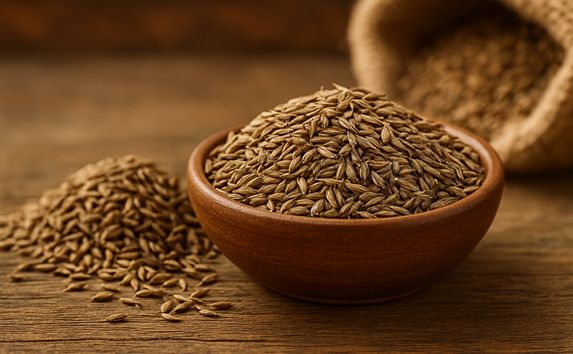
Why India Owns the Global Cumin Market
India holds an 87% share of the global cumin market, exporting to over 175 countries. The industry generated over $616 million in 2023 and is projected to cross $700 million in FY 2024–25, on the back of a 73% volume surge in the April–September 2024 period alone. The sector has compounded at 14% annually for seven straight years — a performance most commodity categories would envy.
But the raw statistics don’t fully explain why. The real answer is more rooted in soil and climate than in spreadsheets.
Gujarat and Rajasthan together account for 90% of India’s cumin output. The semi-arid climate, alkaline soils, and centuries of cultivation knowledge in these two states produce cumin seeds with a volatile oil content of 3.5–4% — the aromatic compound that gives cumin its distinctive warmth and makes it irreplaceable in kitchens from Marrakesh to Minneapolis. Competing origins — Turkey, Iran, Syria — produce cumin, but they do so at 20–30% higher cost and with less processing consistency. For global buyers who want quality, availability, and value in a single source, India is simply the answer.
“When a buyer in Germany or a spice house in Dubai asks for cumin, they aren’t really asking for a commodity. They are asking for the smell of Indian soil — that warm, earthy, unmistakable quality that only comes from Unjha.”
Understanding Cumin Grades: What You Are Actually Buying
This is where many first-time importers get tripped up. “Cumin seeds” on an invoice does not tell you nearly enough. The grade determines purity, cleaning method, aroma intensity, and suitability for your end use. Here is how the grades break down in practice.
MC 98% — Machine Clean (Standard) Purity: 98% | Volatile Oil: 2.5–3.0% | Cleaning: Mechanical, removes dust, stones, debris Best for bulk food processing and spice blending at volume. Primary markets: China, Bangladesh.
MC 99% — Machine Clean (Enhanced) Purity: 99% | Volatile Oil: 2.8–3.2% | Cleaning: Finer mechanical sieving Best for mid-tier blends, culinary distributors, and wholesalers. Primary markets: UAE, USA.
Sortex 99.5% — Full Sortex Purity: 99.5% | Volatile Oil: 3.2–3.8% | Cleaning: Optical colour-sorter removes discoloured and split seeds Best for retail packs, premium spice brands, food service. Primary markets: Europe, UK, Australia.
Europe Grade — Premium Sortex with Compliance Purity: 99.5%+ with strict MRL compliance | Volatile Oil: 3.5–4.0% Cleaning: Optical sorting + pesticide and heavy metal testing + ETO or steam sterilisation Best for organic-certified brands, EU retail, health brands. Primary markets: EU, Scandinavia, Japan.
Organic — NPOP / USDA / EU Certified Purity: 99%+ with full organic chain-of-custody | Volatile Oil: 3.0–4.0% Cleaning: Sortex + certified organic processing, no synthetic pesticides in supply chain Best for organic food brands, supplement manufacturers, premium retail. Primary markets: North America, Europe, Japan.
A quick note on a common source of confusion: black cumin is a separate variety with a sweeter, more delicate aroma. It is not Nigella seeds (kalonji), despite frequent mislabelling in the market. If you are sourcing black cumin, always specify clearly in your purchase contract — disputes over this mislabelling are far more common than they should be.
Quality Parameters Every Serious Buyer Should Verify
A Certificate of Analysis (COA) should accompany every commercial shipment. Before issuing a purchase order, ensure your supplier can provide test results for all of the following:
Moisture content — Maximum 8–10%. Above this, mould can develop during transit. This is the most common cause of shipment rejections globally.
Volatile oil content — Minimum 2.5% for standard grades, 3.5–4% for premium. This is the aromatic value of the seed. Low volatile oil means weak flavour — and unhappy end customers.
Foreign matter — Maximum 1–2% for standard grades; below 0.5% for Sortex and Europe grades.
Purity level — Specified as a percentage. Cross-verify against the grade stated in your contract.
Pesticide residue (MRL compliance) — Mandatory for EU and US markets. Always request a third-party lab report, not just a supplier declaration.
Microbial parameters — Salmonella, E. coli, total plate count. Critical for markets with food safety authority oversight (FDA, EFSA).
Sterilisation method — ETO (ethylene oxide) or steam. Some markets, particularly the EU, have restrictions on ETO; always clarify what is permissible in your destination country.
Pricing in 2026: What to Expect and How to Read It
Cumin prices are not fixed — they respond to harvest yields, global demand, and currency movements. But understanding the broad bands helps you negotiate confidently and spot when a quote is too good (or too expensive) to be true.
Current mandi prices in India are approximately ₹20,000 per quintal (roughly ₹200/kg at farm level). After processing, grading, packaging, and logistics, FOB export prices break down broadly as follows:
MC 98–99% (Standard): $2.00–$2.60 per kg FOB India Sortex 99.5% (Premium): $2.80–$3.40 per kg FOB India Europe Grade (Compliance): $3.40–$3.80 per kg FOB India Organic Certified: $3.80–$5.00+ per kg FOB India
One figure worth holding onto: despite its superior quality, Indian cumin maintains a 20–30% price advantage over Turkish and Iranian origins. For buyers who have been sourcing from the Middle East, switching to India often means better quality at a lower landed cost — a combination that is genuinely rare in commodity sourcing.
Where the Demand Is Coming From in 2026
China — The single largest buyer, accounting for over 60% of Indian cumin exports at peak. Buys at volume for food processing and traditional medicine. Highly price-sensitive; MC 98–99% grade is standard.
Bangladesh — India’s most frequent-shipment market at approximately 1,175 annual shipments. Proximity and deep culinary ties make this a consistent, year-round buyer with reliable repeat orders.
United States — Around 808 annual shipments. Growing demand from health food brands and Latin cuisine expansion. Premium Sortex and organic grades are the focus; FDA compliance is non-negotiable.
UAE and Middle East — Dubai functions as a re-export hub for the wider region. Seasonal peaks around Ramadan. Both MC and Sortex grades move well; buyers value clean documentation and quick turnaround.
Europe — The strictest MRL and pesticide compliance requirements globally. Europe-grade and organic-certified cumin only. Demand is growing strongly among spice brands and health-focused retailers.
Vietnam — An emerging buyer with a rapidly growing food processing industry. Standard grades at volume. An important market to watch as Southeast Asian demand for Indian spices accelerates.
The HS Code, Documentation & Logistics Basics
For buyers new to sourcing from India, a few practical essentials are worth spelling out clearly.
HS Code: 09093100 — Cumin seeds, neither crushed nor ground. Use this consistently across all customs documentation to avoid clearance delays.
Phytosanitary Certificate — Issued by India’s Plant Quarantine department. Mandatory for agricultural commodities entering most countries.
Certificate of Origin — Attested by the Indian Chamber of Commerce. Required for preferential duty treatment under trade agreements.
APEDA Registration of Exporter — Confirms the supplier is authorised to export agricultural products from India. Always verify this before placing an order.
Certificate of Analysis (COA) — Third-party lab report covering moisture, purity, volatile oil, pesticide residues, and microbial counts.
Shipping Terms — FOB from Mundra or Nhava Sheva (JNPT) are the standard departure ports for Gujarat-origin cumin. Confirm incoterms clearly in your contract.
Payment Terms — LC at 60–90 days is standard for first-time buyers. Bank charges typically run 0.75–1.25% of invoice value. Discuss terms openly with your supplier upfront.
Choosing the Right Exporter: What Actually Matters
There are thousands of cumin exporters in India. Many are legitimate. Some are not. And even among the legitimate ones, the difference in reliability can make or break your supply chain.
These are the things that genuinely separate a trustworthy exporter from the rest — not the glossiest website or the lowest opening quote, but the substance beneath:
APEDA registration — Non-negotiable. Without it, the exporter is not legally authorised to ship agricultural products internationally.
In-house processing — Exporters who process in their own facility, rather than outsourcing, offer better consistency, traceability, and quality control.
Willingness to share third-party COAs — Any exporter who hesitates on this is a red flag. Good ones have these ready before you ask.
Clear communication before and after payment — Talk to references. Ask other buyers in your network. The post-payment experience is what separates partners from vendors.
Flexible packaging options — 25 kg PP bags, 50 kg jute bags, vacuum packs, and private label custom packaging. A capable exporter offers choices, not ultimatums.
Experience with your destination market — Exporting to Germany is not the same as exporting to Saudi Arabia. Your supplier should understand the compliance requirements of where you are importing to, not just where they are exporting from.
A Note from Sadbhaav Spices
We have spent years building the kind of export operation that buyers in this guide would recognise as trustworthy. Our cumin is sourced from Gujarat and Rajasthan, processed through our in-house cleaning and sorting facility, and shipped with full documentation — APEDA certification, COA, phytosanitary certificate, and flexible packaging to your specification.
We work with importers in the UAE, Europe, Southeast Asia, and North America. We understand what a first-time buyer needs to feel confident, and what a long-term buyer needs to feel secure. If you are at either end of that journey — or somewhere in between — we would genuinely like to hear from you.
“The best sourcing relationship isn’t a transaction. It’s a supply chain that simply works, shipment after shipment, year after year — because the people on both ends care enough to make it so.”
Ready to Source Cumin from India?
Request a sample, share your specification sheet, or simply start a conversation. We’ll take it from there.
📧 info@sadbhaavspices.com 📞 +91 7397993793 🌐 sadbhaavspices.com/contact