
The Red Sea crisis is disrupting shipments of produce from tea to spices from India, with shipments getting delayed by 21-28 days. Traffic through the Suez Canal and Bab El-Mandeb Strait decreased by half by end of March 2024, while navigation via the Cape of Good Hope route increased by 100%.
For global buyers sourcing spices from India, the question isn’t whether disruptions exist—it’s how Indian exporters are ensuring your orders still arrive on time, at predictable costs, with zero quality compromise.
This guide explains exactly how India’s spice export industry adapted to the Red Sea crisis and why sourcing from Indian suppliers remains more reliable than ever, even through maritime chaos.
The Red Sea Crisis: Understanding What’s Actually Happening
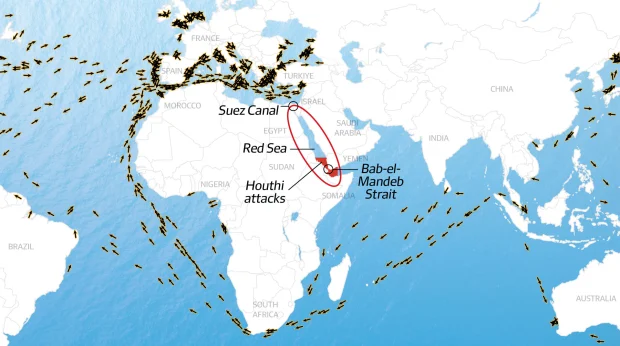
Since November 2023, Houthi attacks (over 190 by October 2024) have significantly disrupted Red Sea and Gulf of Aden shipping, with freight and insurance costs surging as many ships rerouted via Cape of Good Hope.
The Geography of Disruption
The Bab al-Mandeb Strait connecting the Red Sea with Gulf of Aden is one of the world’s busiest shipping lanes, accounting for 12% of total seaborne traded oil and 8% of LNG, with around 12% of global trade (30% of worldwide container traffic) transiting the Strait annually.
For Indian exporters, India is heavily reliant on the Red Sea route through the Suez Canal for its trade with Europe, North America, North Africa and the Middle East, with these regions accounting for about 50% of India’s exports.
The Impact on Shipping Costs
Ocean freight costs have surged amidst the Red Sea disruption, with charges for shipping containers ballooning by 250%, and a 40-foot container from China to Europe now charged an average of $4,000, way higher than the estimated $1,148 pre-November 2023.
Container freight rates from India show average rates from JNPT to Rotterdam rose to $3,750 per 40-foot container from $650—a 477% increase in one month between end January 2023 to end January 2024.
Extended Transit Times
Shifting container routes to the Southern tip of Africa (Cape of Good Hope) results in an extra 3,500 nautical miles and $2 million in fuel costs, while rerouted voyages add 10 to 14 days to transit times.
How Indian Spice Exporters Adapted: Five Strategic Solutions
While global supply chains buckled, Indian spice exporters implemented systematic solutions that actually work.
1. Proactive Route Diversification
The moment Houthi attacks began escalating in November 2023, leading Indian exporters didn’t wait for disruptions to worsen. They immediately began routing shipments via the Cape of Good Hope, absorbing the additional transit time into revised delivery schedules.
What this means for buyers:
- Delivery timelines communicated upfront include rerouting delays
- No surprise delays after order confirmation
- Transparent communication on expected arrival dates
Key advantage: Indian exporters booking Cape route capacity early avoided the severe container shortages that hit European and Middle Eastern suppliers who reacted late.
2. Strategic Port Utilization
India’s west coast ports—particularly Mundra and JNPT (Jawaharlal Nehru Port Trust)—have direct access to alternative shipping routes without dependence on Red Sea transit.
Geographic advantage:
- Mundra Port (Gujarat) handles 40% of India’s spice exports
- Direct shipping lanes to East Africa, Southeast Asia, and Far East markets
- JNPT offers efficient connections to USA West Coast via Pacific routes
- Southern ports like Tuticorin serve Middle East via Oman Sea, bypassing Red Sea entirely
For buyers in USA, Southeast Asia, and East Asia, Indian spice shipments never relied heavily on Red Sea routes in the first place. These markets experienced minimal disruption.
3. Pre-Positioning and Strategic Inventory
Forward-thinking Indian exporters increased finished goods inventory at port warehouses, allowing them to fulfill orders rapidly even when inland transit faced delays.
How this protects buyers:
- Orders can be containerized and shipped within 48-72 hours
- Reduced exposure to sudden freight rate spikes
- Ability to consolidate multiple small orders into full container loads efficiently
Gujarat’s abundant Sortex facilities and cold storage infrastructure enabled this strategy, with many exporters maintaining 30-60 days of export-ready inventory near Mundra and Kandla ports.
4. Freight Hedging and Long-Term Carrier Contracts
Rather than booking spot freight rates (which spiked 250-477%), established Indian spice exporters negotiated long-term contracts with major shipping lines at more stable rates.
Protection mechanism:
- Fixed or capped freight rates for 6-12 month periods
- Priority container allocation during peak demand
- Reduced exposure to sudden market volatility
This means even during the height of the Red Sea crisis, buyers working with strategic Indian suppliers paid significantly less in freight premiums compared to those sourcing from regions without carrier partnerships.
5. Enhanced Communication and Documentation
The crisis forced Indian exporters to upgrade customer communication systems dramatically.
What improved:
- Real-time shipment tracking shared with buyers
- Proactive alerts on potential delays
- Alternative route options presented before order confirmation
- Transparent cost breakdowns showing exact freight components
- Digital documentation reducing customs clearance delays
Many Indian exporters now provide buyers with direct access to container tracking systems, GPS coordinates, and estimated arrival windows—transparency levels previously uncommon in the commodity spice trade.
Why Indian Spice Routes Prove More Resilient Than Alternatives
Geographic Diversification Advantage
Unlike Middle Eastern or Turkish spice suppliers who depend almost entirely on Red Sea-Mediterranean routes, Indian exporters serve global markets through multiple shipping corridors:
Primary Indian Export Routes:
- West Coast to Europe: Via Cape of Good Hope (Red Sea alternative)
- West Coast to USA East Coast: Via Cape of Good Hope or Suez (when clear)
- West Coast to USA West Coast: Direct Pacific route (zero Red Sea exposure)
- West Coast to Middle East: Via Arabian Sea and Oman Sea (bypasses Red Sea conflict zone)
- West Coast to Southeast Asia: Direct Bay of Bengal route (zero Suez exposure)
- East Coast to Southeast Asia/East Asia: Shortest route via Malacca Strait
This route diversity means Indian exporters can redirect shipments based on real-time conditions, something single-route suppliers cannot match.
Cost Absorption Capacity
India’s structural cost advantages in spice production create margins that allow absorbing freight increases without passing full costs to buyers.
Production cost comparison (per kg FOB):
- Indian cumin production cost: ₹180-220 ($2.15-$2.65)
- Turkish/Syrian cumin production cost: ₹280-320 ($3.35-$3.85)
This $1.20-$1.70 per kg structural advantage means Indian exporters can absorb $0.30-$0.50 freight increases while remaining price-competitive with alternatives.
For buyers, this translates to stable pricing even during crisis periods.
Established Infrastructure Resilience
Indian ports didn’t just survive the Red Sea crisis—they thrived.
Port performance during crisis:
- Mundra Port expanded spice handling capacity by 15% in 2024
- JNPT reduced container dwell time from 3.2 days to 2.1 days
- New Sortex facilities near ports reduced pre-shipment processing time by 25%
Key Indian export sectors like petroleum products, cereals, and chemicals were impacted by Red Sea uncertainty, but spice exporters proved more adaptive due to smaller shipment sizes, established alternative routes, and flexible logistics infrastructure.
Real Impact on Different Buyer Markets
European Buyers (UK, Netherlands, Germany, France)
Challenge: Heaviest reliance on Red Sea-Suez route
Indian solution: Cape of Good Hope routing with 10-14 day extended transit
Outcome: Predictable delays communicated upfront; freight increases moderated through long-term contracts
Buyer action: Plan inventory 4 weeks ahead instead of 2 weeks; work with suppliers offering consolidated container loading to share freight costs.
Middle East Buyers (UAE, Saudi Arabia, Qatar, Kuwait)
Challenge: Geographic proximity to conflict zone
Indian solution: Arabian Sea routing via Oman Sea, completely bypassing Red Sea
Outcome: Minimal disruption; some buyers actually experienced faster delivery than pre-crisis
Buyer action: Continue normal procurement cycles; consider increasing order frequency to capitalize on stable routes.
North American Buyers (USA, Canada)
Challenge: East Coast shipments affected; West Coast routes unaffected
Indian solution: Pacific routing for West Coast; Cape routing for East Coast
Outcome: West Coast buyers experienced zero disruption; East Coast buyers faced 10-12 day delays but stable pricing
Buyer action: East Coast importers should adjust lead times; West Coast buyers maintain normal scheduling.
Southeast Asian Buyers (Malaysia, Singapore, Indonesia, Vietnam)
Challenge: Minimal to zero impact
Indian solution: Direct Bay of Bengal and Malacca Strait routes never used Red Sea
Outcome: Business as usual with no delays or cost increases
Buyer action: No changes required; capitalize on supply chain stability to increase market share.
What Buyers Should Demand from Indian Spice Suppliers
Not all Indian exporters adapted equally well. Use these criteria to separate professionals from opportunists:
1. Transparent Freight Breakdown
Request itemized costing showing:
- Base FOB price
- Inland transport to port
- Ocean freight (specify route)
- Insurance
- Port charges
- Total CFR/CIF price
Red flag: Supplier unwilling to break down freight components separately or claims “freight included” without specifics.
2. Route Confirmation in Writing
Demand written confirmation of:
- Exact shipping route (Cape of Good Hope vs. Suez Canal)
- Expected transit time with buffer
- Contingency plan if primary route becomes unavailable
Red flag: Vague answers like “via normal route” or “fastest available.”
3. Real-Time Tracking Access
Professional suppliers provide:
- Container tracking number upon vessel loading
- Access to carrier tracking system
- Proactive updates if delays occur
- Estimated arrival window at destination port
Red flag: “We’ll inform you when it arrives” mentality without interim tracking.
4. Carrier Relationship Verification
Ask suppliers:
- Which shipping lines do you regularly work with?
- Do you have long-term contracts or book spot rates?
- Can you guarantee container availability for my order date?
Red flag: Different carrier on every shipment suggests spot market dependence with no freight hedging.
5. Port Diversification Options
Verify the supplier can ship from:
- Primary port (typically Mundra or JNPT)
- Alternative port if congestion occurs
- Southern ports (Tuticorin, Kochi) for Middle East shipments
Red flag: Single-port dependence creates vulnerability to port strikes or congestion.
The Silver Lining: How Crisis Improved Indian Spice Exports
Paradoxically, the Red Sea crisis strengthened Indian spice supply chains in several ways:
Infrastructure Upgrades
- New container freight stations near Mundra and JNPT
- Expanded cold storage capacity for climate-sensitive spices
- Faster customs clearance systems to reduce port dwell time
Digital Transformation
- Widespread adoption of real-time tracking systems
- Electronic documentation reduces clearance delays
- Better inventory management systems for faster order fulfillment
Carrier Relationships
- Long-term freight contracts providing rate stability
- Priority allocation during capacity crunches
- Better service levels from shipping lines competing for India business
Quality Improvements
- More rigorous pre-shipment quality checks to avoid costly rejections
- Better packaging to withstand extended transit times via Cape route
- Enhanced fumigation and pest control for longer voyages
Cost Reality Check: What Buyers Actually Pay
Despite freight increases, Indian spice exports remain competitively priced due to production advantages.
Example: Cumin Export Pricing (2024-2025)
Pre-Crisis (October 2023):
- FOB Mundra: $3.20/kg
- Freight to Rotterdam: $0.04/kg
- Total CFR: $3.24/kg
During Crisis (March 2024):
- FOB Mundra: $3.20/kg
- Freight to Rotterdam (Cape route): $0.18/kg
- Total CFR: $3.38/kg
Net increase: $0.14/kg (4.3%)
Compare this to Turkish cumin alternative:
- FOB Turkey: $4.10/kg
- Freight to Rotterdam (Mediterranean, unaffected): $0.03/kg
- Total CFR: $4.13/kg
Indian cumin via Cape route remains 18% cheaper than Turkish alternative, even with crisis freight premiums.
Looking Forward: What Happens When Red Sea Normalizes?
The January 2025 ceasefire offers cautious optimism, but experts warn of lingering challenges, with carriers like Maersk remaining cautious about returning to Red Sea routes.
Scenario 1: Gradual Red Sea Reopening (Most Likely)
What to expect:
- Slow return to Suez route as carriers test security
- Freight rates declining but not immediately to pre-crisis levels
- Transit times improving by 7-10 days as Suez reopens
- Continued Cape routing by risk-averse carriers for 6-12 months
Buyer strategy: Maintain relationships with Indian suppliers who proved reliable during crisis; benefit from improved transit times without switching sources.
Scenario 2: Prolonged Instability (Moderate Probability)
What to expect:
- Cape of Good Hope becomes standard route for 18-24 months
- Freight rates stabilize at “new normal” 30-50% above pre-crisis
- Shipping lines add capacity on Cape route, improving schedules
- Indian port infrastructure continues optimizing for longer routes
Buyer strategy: Lock in long-term contracts with Indian suppliers to cap freight exposure; adjust inventory planning for extended lead times.
Scenario 3: Alternative Crises Emerge (Low but Possible)
What to watch:
- Panama Canal drought restrictions continuing
- Malacca Strait security concerns
- Port strikes in major hubs
- Climate events disrupting specific routes
Buyer strategy: Diversify supplier base across multiple Indian ports (Gujarat, Tamil Nadu, Kerala) to spread route risk.
The Bottom Line: Why Indian Spice Exports Remain Your Best Bet
The Red Sea crisis tested global supply chains like nothing since COVID. The results are clear:
Indian spice exporters demonstrated:
- Route flexibility is unavailable to single-corridor suppliers
- Cost absorption capacity due to structural production advantages
- Infrastructure resilience through diversified port access
- Proactive communication and transparency
- Long-term thinking vs. spot-market opportunism
What buyers gained:
- Reliable delivery even through peak disruption
- Predictable costs despite freight volatility
- Quality consistency maintained across extended transit
- Enhanced tracking and documentation systems
- Stronger supplier relationships built on crisis performance
While competing origins struggled with route dependencies and freight exposure, India’s spice export ecosystem proved it can deliver through maritime chaos, geopolitical instability, and supply chain shocks.
For global buyers, the lesson is simple: source from suppliers who proved themselves when tested, not those offering lowest prices during calm periods.
Indian spice exporters passed that test.
About Sadbhaav Spices
At Sadbhaav Spices, we maintained uninterrupted deliveries throughout the Red Sea crisis through strategic route diversification, long-term carrier partnerships, and enhanced inventory positioning at Mundra Port. Our shipments to Europe, Middle East, and North America continued without a single delay-related cancellation.
We offer transparent freight breakdowns, real-time container tracking, and route confirmation for every order. Our relationships with Maersk, MSC, and CMA CGM secured container availability even during peak capacity crunches.
From cumin and coriander to turmeric and cardamom, our supply chain proved resilient when others faltered. We source from Gujarat and Rajasthan’s premier regions, process through ISO 22000 certified facilities, and ship from multiple ports to serve your market with zero compromise on quality or timeline.
Need reliable spice supply that delivers even through global disruptions? Talk to our export team about route options, transparent pricing, and crisis-tested logistics.