The United States represents the holy grail for psyllium husk exporters, consuming a staggering 68% of global psyllium imports worth over $300 million annually. American pharmaceutical companies manufacturing over-the-counter laxatives (Metamucil-style products), supplement brands producing digestive health formulas, food manufacturers developing gluten-free products, and nutraceutical companies creating fiber-based wellness solutions all require consistent, high-quality psyllium supplies. Yet despite this massive opportunity, many Indian exporters struggle to crack the USA market due to one formidable barrier: FDA compliance requirements that reject over 30% of first-time psyllium shipments.
The Food and Drug Administration (FDA) enforces the world’s strictest food safety standards. A single Salmonella-positive test result triggers automatic detention, destroying thousands of dollars in product and permanently damaging your exporter reputation. Aflatoxin levels exceeding 20 parts per billion result in immediate rejection. Missing documentation or incorrect Prior Notice filings delay customs clearance, spoiling time-sensitive shipments. Pesticide residues above EPA tolerance levels blacklist suppliers from future imports.
After successfully exporting pharmaceutical-grade psyllium husk to USA buyers through Sadbhaav Spices for nearly a decade—maintaining a zero rejection rate across hundreds of containers—I’ve developed comprehensive systems ensuring FDA compliance from farm sourcing through customs clearance. This guide reveals everything you need to know about exporting psyllium husk to the USA: regulatory requirements, quality specifications, documentation protocols, testing procedures, and proven strategies avoiding costly mistakes that derail competitors.
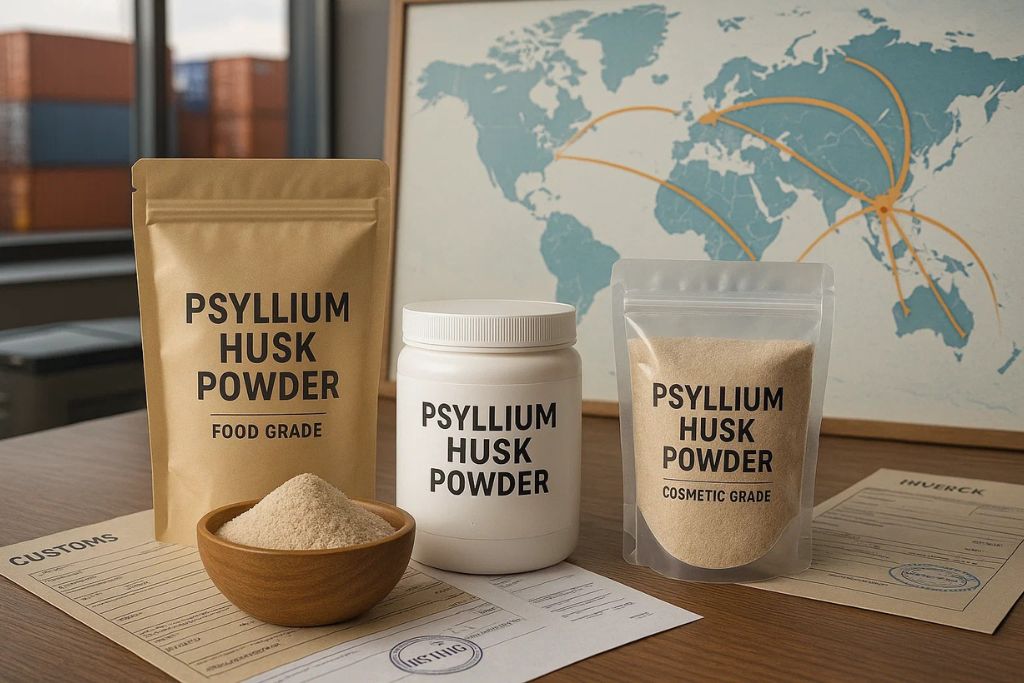
Whether you’re an established Indian exporter targeting USA expansion, a Gujarat processor seeking premium markets, or an American buyer researching reliable suppliers, this comprehensive roadmap ensures successful psyllium exports meeting FDA’s exacting standards.
Understanding the USA Psyllium Market: Why It Dominates Global Demand
Market Size & Growth Trajectory
The USA imports 35,000-40,000 metric tonnes of psyllium husk annually, representing:
- 68% of global psyllium trade (far exceeding all other countries combined)
- $45-50 million annual import value
- 10-12% year-over-year growth driven by digestive health awareness
- 95% sourced from India (minimal competition from Pakistan, China)
This dominance stems from multiple demand drivers:
Pharmaceutical Sector: Major OTC laxative brands (Procter & Gamble’s Metamucil, generic fiber supplements) require pharmaceutical-grade psyllium meeting USP (United States Pharmacopeia) specifications. These products generate billions in retail sales, creating consistent industrial demand for bulk psyllium supplies.
Dietary Supplement Industry: The USA supplement market exceeds $50 billion annually, with digestive health representing the fastest-growing category. Brands like NOW Foods, Nature’s Way, Yerba Prima, and thousands of private-label manufacturers formulate fiber supplements requiring 95-99% purity psyllium husk and powder.
Health & Wellness Trend: American consumers increasingly prioritize gut health, with “fiber supplement” Google searches growing 45% over five years. Physicians recommend psyllium for constipation relief, cholesterol management, blood sugar regulation, and weight management—driving prescription and recommendation-based purchases.
Gluten-Free Movement: Celiac disease awareness and gluten sensitivity concerns created massive demand for gluten-free baking ingredients. Psyllium husk functions as essential binding agent replacing gluten in bread, pizza crust, muffins, and pasta—making it indispensable for gluten-free food manufacturers and artisan bakeries.
Clean Label Preference: American consumers reject synthetic additives, favoring natural ingredients. Psyllium’s “plant fiber” positioning appeals to this demographic better than synthetic alternatives like methylcellulose or hydroxypropyl methylcellulose.
USA Buyer Segments
Pharmaceutical Companies (30% of market):
- Major brands: Procter & Gamble (Metamucil), Perrigo, generic manufacturers
- Requirements: USP-grade, GMP-certified processing, validated sterilization
- Volume: 100-500 tonnes per buyer annually
- Pricing: Premium ($12,000-15,000/tonne FOB)
- Loyalty: Multi-year contracts with strict quality audits
Supplement Brands (45% of market):
- Companies: NOW Foods, Nature’s Way, Yerba Prima, Solaray, private labels
- Requirements: 95-98% purity, organic options, various mesh sizes
- Volume: 5-50 tonnes per buyer annually
- Pricing: Mid-range ($8,000-12,000/tonne FOB)
- Loyalty: Annual contracts with quarterly reviews
Food Manufacturers (15% of market):
- Applications: Gluten-free baking, fiber-enriched products, vegan formulations
- Requirements: Food-grade certification, functional performance testing
- Volume: 2-20 tonnes per buyer annually
- Pricing: Competitive ($7,000-10,000/tonne FOB)
- Loyalty: Recipe-specific; switching costs high
Distributors & Wholesalers (10% of market):
- Role: Aggregate imports for smaller downstream buyers
- Requirements: Consistent quality, flexible packaging, reliable supply
- Volume: 10-100 tonnes annually
- Pricing: Low-margin ($6,500-9,000/tonne FOB)
- Loyalty: Price-sensitive; multiple supplier relationships
Understanding your target segment determines quality specifications, pricing strategy, and compliance priorities.
FDA Regulatory Framework: Core Compliance Requirements
Food Safety Modernization Act (FSMA)
The FDA’s Food Safety Modernization Act represents the most significant food safety reform since the 1930s, shifting focus from responding to contamination to preventing it. Key FSMA requirements affecting psyllium exporters:
Foreign Supplier Verification Program (FSVP):
- USA importers must verify their foreign suppliers (you) meet FDA safety standards
- Requires documented hazard analysis of your facility and processes
- Annual audits or third-party certifications demonstrating compliance
- Action for Exporters: Maintain comprehensive quality documentation, welcome buyer audits, obtain recognized certifications (ISO 22000, HACCP)
Preventive Controls for Human Food:
- Food facilities must implement written food safety plans
- Identify potential hazards (biological, chemical, physical)
- Establish preventive controls and monitoring procedures
- Maintain records proving control effectiveness
- Action for Exporters: Document your hazard analysis critical control points (HACCP), preventive measures for Salmonella/aflatoxin, and testing protocols
Produce Safety Rule:
- Though psyllium is dried (not fresh produce), raw agricultural commodities face scrutiny
- Good Agricultural Practices (GAP) expected for farm sourcing
- Water quality, worker hygiene, equipment sanitation requirements
- Action for Exporters: Source from farms implementing GAP, document farming practices, ensure proper post-harvest handling
Bioterrorism Act Registration
Mandatory FDA Registration:
All food facilities manufacturing, processing, packing, or holding food for USA consumption must register with FDA—even if located outside USA.
Registration Process:
- Visit FDA’s Food Facility Registration portal
- Complete Form FDA 3537 (Food Facility Registration)
- Provide facility details: name, address, parent company, processing activities
- Designate USA agent (representative for FDA communications)
- Receive 11-digit registration number (required for all shipments)
- Renew biennially (every two years, October-December)
USA Agent Requirement:
Foreign facilities must designate a USA-based agent who:
- Resides or maintains business in USA
- Serves as FDA communication point
- Must be available for FDA inspections or inquiries
- Can be your importer, customs broker, or third-party service ($200-500 annual fee)
Penalties: Exporting without FDA registration results in automatic shipment detention and possible permanent import ban.
Prior Notice Requirements
Every psyllium shipment entering USA requires advance electronic notification to FDA before arrival.
What to File:
- Product description (psyllium husk powder, 95% purity, etc.)
- Quantity and value
- Country of origin (India)
- Shipper details (your company name, address, FDA registration number)
- Grower details (if known, or state “multiple farms in Gujarat”)
- Manufacturer/processor details (your facility)
- Intended use (dietary supplement, pharmaceutical, food ingredient)
- Anticipated arrival date, time, and location (USA port)
- Carrier and mode of transportation
- FDA product code and country code
Filing Deadlines:
- Sea freight: 4 hours before arrival at USA port
- Air freight: 4 hours before arrival
- Road freight (from Mexico/Canada): 2 hours before arrival
How to File:
- FDA’s Prior Notice System Interface (PNS)
- Through customs broker or freight forwarder (most common)
- Automated systems (if high-volume exporter)
Consequences of Missing/Incorrect Prior Notice:
- Shipment held at port pending filing
- Demurrage charges ($200-500 per day)
- Product spoilage risk
- FDA red flags for future shipments
Best Practice: Work with experienced customs brokers familiar with psyllium Prior Notice requirements. At Sadbhaav Spices, we provide complete Prior Notice information to our USA buyers/brokers 7-10 days before shipping, allowing ample review time before FDA filing deadline.
Zero-Tolerance Standards: Salmonella & Microbial Safety
FDA’s Salmonella Policy for Spices and Herbs
Following a 2013 investigation revealing 7% of imported spices contained Salmonella, FDA implemented aggressive testing and enforcement. Psyllium husk—being an uncooked agricultural product—faces zero-tolerance policy: any detection of Salmonella results in immediate detention and destruction.
Why Salmonella Matters:
- Causes 1.35 million foodborne illnesses annually in USA
- Especially dangerous in products consumed without cooking (supplements taken directly)
- Can survive in dry products like psyllium for months
- Previous psyllium shipments rejected for Salmonella contamination created industry-wide scrutiny
FDA Salmonella Testing:
- Random sampling at port of entry (5-10% of shipments tested)
- Alert focus on Coriander seeds import India, Pakistan psyllium due to historical violations
- Analysis takes 3-5 days; shipment held pending results
- Positive result triggers automatic detention, supplier red-flagging
Preventing Salmonella Contamination
Source Control:
- Raw psyllium husk naturally carries environmental bacteria from fields
- Gujarat’s farming practices (manual harvesting, outdoor drying) increase contamination risk
- Solution: Source from farms implementing Good Agricultural Practices (GAP)—proper worker hygiene, clean harvesting equipment, controlled drying environments
Processing Controls:
- Mechanical cleaning, destoning, air aspiration remove surface contamination but don’t eliminate embedded microbes
- Critical Control Point: Sterilization treatment before export
Sterilization Methods Meeting FDA Requirements:
1. Steam Sterilization (Recommended):
- Process: Superheated steam (130-145°C) for 15-30 seconds
- Efficacy: Reduces microbial load 99.99% (4-log reduction)
- Advantages:
- Chemical-free (organic-compliant)
- No residues requiring testing
- Maintains product quality (color, swelling capacity)
- FDA and USDA Organic approved
- Equipment: Flash steam sterilizer with precise temperature control
- Validation: Temperature-time charts documenting each batch
- Cost: Moderate ($100-150 per tonne processing cost)
2. Ethylene Oxide (ETO) Treatment:
- Process: Gas fumigation (450-1,200 mg/L) for 4-12 hours
- Efficacy: 99.999% microbial reduction (5-log)
- Advantages:
- Extremely effective
- No heat damage
- Disadvantages:
- Chemical residues (must test <50 ppm)
- FDA scrutiny on ETO levels
- Many USA buyers avoid ETO due to health concerns
- Requires aeration period (24-72 hours)
- Recommendation: Avoid ETO for USA unless buyer specifically requests; steam sterilization preferred
3. Gamma Irradiation:
- Process: Cobalt-60 gamma rays (5-10 kGy dose)
- Efficacy: Complete microbial elimination
- Advantages:
- FDA-approved for spices and herbs
- No chemical residues
- Can sterilize finished packaged products
- Disadvantages:
- Limited availability (specialized facilities only)
- Higher cost ($1-2 per kg)
- Consumer perception concerns (despite safety)
- Recommendation: Excellent option for pharmaceutical-grade; overcomes some buyers’ ETO concerns
Post-Sterilization Handling:
- Sterilized product must avoid recontamination
- Clean room packaging environments
- Sterile packaging materials
- Sealed containers until final use
Laboratory Verification:
Every export batch should undergo pre-shipment Salmonella testing:
- Test method: AOAC 2003.09 or FDA BAM Chapter 5
- Sample size: Representative 375g composite from batch
- Laboratory: NABL-accredited microbiology lab
- Results: Certificate stating “Salmonella: Absent in 25g”
- Cost: $50-100 per test
Investment in Prevention vs Cost of Rejection:
- Pre-shipment testing + steam sterilization: $150-250 per tonne
- Rejected container: $15,000-25,000 (product loss + freight + documentation)
- Damaged reputation: Priceless
At Sadbhaav Spices, we’ve implemented a three-layer Salmonella prevention system: GAP-compliant farm sourcing, validated steam sterilization with continuous monitoring, and 100% batch testing before shipment. This investment costs approximately $200 per tonne but has delivered zero Salmonella detections across a decade of USA exports—proving prevention dramatically outweighs rejection costs.
Additional Microbial Specifications
Beyond Salmonella zero-tolerance, FDA and USA buyers expect:
Standard Requirements (Dietary Supplements/Food):
- Total Plate Count: <10,000 CFU/g
- Yeast & Mold: <1,000 CFU/g
- E. coli: <10 CFU/g
- Coliforms: <100 CFU/g
Pharmaceutical Grade (USP Requirements):
- Total Plate Count: <1,000 CFU/g
- Yeast & Mold: <100 CFU/g
- E. coli: Absent in 1g
- Salmonella: Absent in 25g
Proper sterilization achieves these specifications reliably, protecting both exporter and importer from regulatory and product safety issues.
USP Grade Specifications: Pharmaceutical Excellence
United States Pharmacopeia (USP) Standards
For pharmaceutical companies manufacturing OTC laxatives or prescription formulations, USP compliance is non-negotiable. The United States Pharmacopeia establishes quality standards for drugs, supplements, and pharmaceutical ingredients used in USA.
USP Monograph for Psyllium Husk (Plantago Seed):
The official USP-NF monograph (National Formulary) specifies:
Botanical Identity:
- Source: Plantago ovata Forssk. (Blonde psyllium) or Plantago afra L. (Black psyllium)
- Part Used: Dried ripe seed coat (epidermis)
- Note: Most USA buyers prefer Plantago ovata (blonde) due to superior mucilage content
Physical Characteristics:
- Description: Light cream to pale brown, flattened-oval fragments with boatlike inner surface
- Odor: Slight, characteristic
- Taste: Mucilaginous when chewed
Chemical Testing:
1. Identification Tests:
- Microscopic Examination: Characteristic cell structure under microscope
- Mucilage Test: Forms viscous gel when mixed with water
- Acid-Base Test: Specific reaction patterns confirming psyllium
2. Assay Requirements:
- Swelling Index: Minimum 40ml per gram (measures mucilage functionality)
- Acid-Insoluble Ash: Maximum 2.0% (ensures low sand/soil contamination)
- Total Ash: Maximum 4.0% (indicates overall purity)
3. Microbial Limits:
- Total Aerobic Count: <1,000 CFU/g
- Yeast & Mold: <100 CFU/g
- Bile-Tolerant Gram-Negative Bacteria: <10 CFU/g
- E. coli: Absent in 1g
- Salmonella: Absent in 25g
4. Contaminant Limits:
- Heavy Metals:
- Lead: <2 ppm
- Cadmium: <0.5 ppm
- Arsenic: <2 ppm
- Mercury: <0.1 ppm
- Pesticide Residues: Must meet EPA tolerances (see section below)
- Aflatoxins: <20 ppb total aflatoxins
5. Physical Contaminants:
- Foreign Matter: <2% (stems, seeds, other plant parts)
- Inorganic Matter: <0.5% (sand, stones)
Testing and Documentation for USP Compliance
Laboratory Requirements:
- Testing must be conducted by ISO 17025 accredited laboratory
- India’s NABL-accredited labs can perform most USP tests
- Some pharmaceutical buyers require USA laboratory confirmation (costs $500-1,500 per comprehensive test)
Certificate of Analysis (CoA):
Every USP-grade shipment requires detailed CoA stating:
- Batch/lot number with traceability
- Manufacturing date and expiry date
- All USP test results with acceptable ranges
- Statement: “Tested and found compliant with USP-NF monograph specifications”
- Laboratory accreditation details
- Authorized signatory with stamp
Certificate of Compliance:
Separate document stating: “This product is manufactured in accordance with USP-NF monograph requirements for Psyllium Husk and meets all specifications therein.”
Supplier Qualification:
Pharmaceutical companies conduct supplier audits before approving new psyllium sources:
- Facility inspection (GMP compliance)
- Quality system review (documentation, procedures)
- Testing capability verification
- Traceability demonstration
- Stability data review (proving shelf-life claims)
Passing supplier qualification can take 3-6 months but opens doors to high-volume, premium-priced contracts.
Aflatoxin Control: Meeting FDA Action Levels
Understanding Aflatoxin Risk in Psyllium
Aflatoxins are carcinogenic compounds produced by Aspergillus flavus and Aspergillus parasiticus molds growing on agricultural products stored under poor conditions. Psyllium husk—being hygroscopic (moisture-absorbing)—faces significant aflatoxin risk if:
- Harvested at high moisture (>14%)
- Dried insufficiently (>12% final moisture)
- Stored in warm, humid conditions
- Contaminated before or during storage
FDA Action Level for Aflatoxin:
- Total Aflatoxins: 20 ppb (parts per billion) maximum
- Includes: Aflatoxin B1, B2, G1, G2 combined
- Enforcement: Shipments exceeding 20 ppb automatically detained and destroyed
Aflatoxin Prevention Strategy
1. Farm-Level Control:
- Timely Harvest: Harvest when seed heads turn brown and moisture drops below 15%
- Rapid Drying: Dry to 10-12% moisture within 24-48 hours post-harvest
- Sun Drying Caution: Monitor moisture continuously; don’t leave on ground overnight
- Mechanical Drying Preferred: Controlled temperature (45-60°C) ensures uniform drying
2. Procurement Standards:
- Test moisture content of all incoming raw husk (reject >12%)
- Visual inspection for mold, discoloration, off-odors (immediate rejection)
- Sample testing for aflatoxin (reject lots >5 ppb to build safety margin)
3. Storage Conditions:
- Climate-Controlled Warehouses: Temperature <25°C, humidity <60% RH
- Moisture-Proof Packaging: HDPE bags with inner liners preventing moisture absorption
- Elevated Storage: Wooden pallets keeping product off floor
- Regular Monitoring: Monthly moisture checks, quarterly aflatoxin testing
- FIFO System: First-in-first-out rotation preventing prolonged storage
4. Processing Safeguards:
- Clean equipment preventing cross-contamination from moldy batches
- Rapid processing (minimize warehouse time before shipment)
- Final moisture verification before packaging (<12%)
Aflatoxin Testing Protocol
Test Method:
- ELISA Screening: Rapid immunoassay detecting aflatoxin presence (results in 30 minutes, cost $30-50)
- HPLC Confirmation: High-Performance Liquid Chromatography for precise quantification (results in 2-3 days, cost $100-150)
Testing Frequency:
- Incoming Raw Material: ELISA screening of every 10-tonne lot
- Final Product: HPLC quantification of every export batch
- Storage Monitoring: Quarterly testing of stored inventory
Sample Collection:
- Representative sampling critical (aflatoxin distributes unevenly)
- Collect 1kg from at least 10 different locations in batch
- Mix thoroughly and take 100g analytical sample
Documentation:
Certificate stating: “Tested for Aflatoxin (B1, B2, G1, G2) by HPLC per AOAC Official Method 994.08. Total Aflatoxins: <5 ppb (FDA Action Level: 20 ppb).”
Cost-Benefit Reality:
- Aflatoxin testing: $100-150 per batch
- Rejected container value: $15,000-25,000
- Return on investment: 100-250x
At Sadbhaav Spices, we implement a zero-tolerance internal policy: any batch exceeding 5 ppb aflatoxin (well below FDA’s 20 ppb limit) is rejected for USA export and diverted to less stringent markets or industrial applications. This 75% safety margin has prevented USA rejections despite occasional aflatoxin detection in stored inventory.
Pesticide Residues: EPA Compliance Requirements
EPA Tolerance Levels
The Environmental Protection Agency (EPA) establishes Maximum Residue Limits (MRLs) for pesticides in food products. While psyllium doesn’t have specific EPA tolerances listed (being a relatively minor crop), it falls under default tolerances or general herb/spice categories.
Common Pesticide Violations in Indian Psyllium:
- Chlorpyrifos: Organophosphate insecticide (banned in USA but used in India)
- Profenofos: Another organophosphate (USA tolerance: 0.05 ppm for most foods)
- Triazophos: Insecticide (no USA tolerance—zero allowed)
- Quinalphos: Insecticide (restricted USA use)
- Acephate: Organophosphate (USA tolerance: 0.02-10 ppm depending on crop)
FDA Enforcement:
- Import Alerts: Products from countries with repeated pesticide violations face automatic detention until proven compliant
- Multi-Residue Screening: FDA tests for 200+ pesticide compounds
- Violations: Shipments exceeding EPA tolerances detained and destroyed
Pesticide Prevention Strategies
1. Organic Sourcing (Ultimate Solution):
- USDA Organic Certification: Eliminates synthetic pesticide concerns entirely
- Premium pricing (30-50% higher) justifies investment
- Growing USA consumer preference for organic
- Recommended for high-value pharmaceutical and premium supplement segments
2. Certified GAP (Good Agricultural Practices) Farms:
- Farm partnerships implementing integrated pest management (IPM)
- Approved pesticide lists (only EPA-registered compounds)
- Pre-harvest intervals (minimum days between pesticide application and harvest)
- Training farmers on proper application rates and timing
3. Multi-Residue Testing:
- Test Method: GC-MS/MS or LC-MS/MS (Gas or Liquid Chromatography-Mass Spectrometry)
- Screening: 200+ pesticide compounds in single test
- Frequency: Every export batch before shipment
- Cost: $300-500 per comprehensive multi-residue test
- Laboratory: NABL-accredited lab with ISO 17025 certification
4. Supplier Declarations:
- Farmers sign declarations regarding pesticide use
- List specific compounds applied, dates, and dosages
- Provides traceability if violations detected
Documentation for Pesticide Compliance
Certificate of Analysis:
“Multi-residue pesticide analysis conducted per AOAC Official Method 2007.01 (QuEChERS). Tested for 200+ pesticides. Results: All pesticides below EPA tolerance levels OR All pesticides: Not Detected (LOD: 0.01 ppm).”
Organic Certificate (if applicable):
USDA Organic certification eliminates need for pesticide testing—certificate itself demonstrates compliance.
Best Practice Recommendation:
For USA pharmaceutical and premium supplement buyers, organic certification provides the most reliable pesticide compliance path. The 30-50% price premium outweighs the complexity and uncertainty of managing conventional pesticide compliance.
Sadbhaav Spices maintains both organic and conventional processing lines—organic for USA pharmaceutical and premium buyers, conventional (with rigorous testing) for cost-conscious industrial buyers. This dual approach maximizes market access while ensuring compliance.
Import Duties & Customs Procedures
Harmonized Tariff Schedule (HTS) Classification
Correct tariff classification determines import duties, quotas, and regulatory requirements.
Psyllium Husk HTS Code:
- 1211.90.9210: Psyllium husk (not manufactured, raw agricultural product)
- 1302.31.0000: Mucilages and thickeners (if processed/extracted)
Import Duty Rates (2025):
- Normal Trade Relations (NTR): 0% (duty-free for psyllium husk)
- Special Tariff Programs: N/A (already duty-free)
Good News: Psyllium husk imports from India enter USA duty-free, eliminating tariff costs and simplifying pricing calculations.
Importation Process:
1. Entry Filing:
- Within 15 days of arrival, importer (or customs broker) files Customs Entry
- Provides commercial invoice, packing list, Bill of Lading
- Declares HTS code, value, origin
2. FDA Review:
- FDA receives Prior Notice and may select shipment for examination
- Physical inspection (5-10% of shipments) or document review only
- Sampling for Salmonella, aflatoxin, pesticide testing (random or targeted)
3. Release or Detention:
- Released: Shipment cleared for entry; importer collects from port
- Detained: FDA issues “Refusal to Admit” pending testing or documentation
- Refused: If tests fail, shipment destroyed or re-exported at exporter’s expense
4. Customs Bond:
- Importers must post customs bond (surety bond) covering potential duties, fees, penalties
- Continuous bond ($50,000-100,000) for regular importers
- Single-transaction bond for occasional imports
Import Documentation Requirements
Comprehensive paperwork essential for smooth customs clearance:
Commercial Invoice:
- Exporter details (your company name, address, FDA registration number)
- Importer details (buyer’s name, address, IRS number)
- Product description (Psyllium Husk Powder, 95% Purity, 60-mesh)
- HTS Code: 1211.90.9210
- Quantity (net weight, gross weight)
- Unit price and total value (FOB India)
- Payment terms
- Country of origin: India
Packing List:
- Number of cartons/bags
- Weight per package (net and gross)
- Pallet details
- Container number and seal number
- Marks and numbers on packages
Bill of Lading (B/L):
- Ocean carrier’s receipt and contract of carriage
- Original B/L required for cargo release
- Consigned to importer or “To Order” (for negotiable B/L)
- Notify party details
Certificate of Origin:
- Issued by Indian Chamber of Commerce
- States: “The goods described herein originate from India”
- Required for customs clearance and duty exemption verification
Phytosanitary Certificate:
- Issued by India’s Plant Quarantine authorities
- Certifies product free from pests and plant diseases
- Required by USA APHIS (Animal and Plant Health Inspection Service)
- States fumigation treatment (if conducted)
Certificate of Analysis (CoA):
- NABL-accredited laboratory test results
- All quality parameters (purity, moisture, particle size, swelling index)
- Microbial testing (Salmonella: Absent in 25g, TPC, yeast/mold)
- Aflatoxin testing (<20 ppb)
- Pesticide multi-residue screening
- Heavy metals analysis
FDA Registration Certificate:
- Copy of your facility’s FDA registration confirmation
- Shows 11-digit registration number
- Proves compliance with facility registration requirement
FSSAI License (if requested):
- Indian food safety license demonstrating domestic compliance
- Not required by FDA but builds credibility
Organic Certificate (if applicable):
- USDA Organic certificate for organic products
- Scope certificate showing certified products
- Transaction certificate for specific shipment
ISO/HACCP Certificates (if requested):
- ISO 22000, HACCP certification copies
- Demonstrates quality management systems
- Pharmaceutical buyers often require
Fumigation Certificate (if wooden pallets used):
- ISPM-15 compliance for heat-treated pallets
- Required to prevent pest introduction
- Issued by authorized fumigation agencies
Insurance Certificate:
- Cargo insurance covering goods in transit
- Typically 110% of invoice value
- Protects against loss, damage, or rejection
USA Agent & Communication
Your designated USA Agent serves as FDA’s contact point:
- Must respond to FDA inquiries within reasonable timeframes
- Coordinates inspections if FDA requests facility visit
- Receives FDA communications regarding your shipments
- Should be reliable (customs broker, importer, or professional agent service)
Common USA Ports for Psyllium Imports:
- Port of Newark/New York: East Coast pharmaceutical hub
- Port of Los Angeles/Long Beach: West Coast supplement concentration
- Port of Houston: Gulf Coast distribution center
- Port of Savannah: Growing Southeast import gateway
Choose port based on buyer’s location minimizing inland transportation costs and transit time.
Best Practices for Consistent USA Export Success
Quality System Implementation
1. Batch Traceability:
- Assign unique batch numbers to every production run
- Link batch number to source farms, processing date, testing results
- Maintain records minimum 2 years (preferably 5 years for pharmaceutical)
- Enable rapid recall if issues detected
2. Standard Operating Procedures (SOPs):
- Document every processing step (cleaning, grinding, sieving, sterilization, packaging)
- Include critical control points, monitoring frequency, corrective actions
- Train staff on SOPs and maintain training records
- Update SOPs when processes change
3. Preventive Maintenance:
- Schedule regular equipment maintenance preventing contamination or malfunctions
- Calibrate testing equipment (moisture meters, scales, thermometers) quarterly
- Document all maintenance and calibration activities
4. Supplier Qualification:
- Qualify raw material suppliers (farms, traders)
- Audit farming practices, storage conditions, quality controls
- Test incoming material before acceptance
- Maintain approved supplier lists
5. Customer Communication:
- Provide complete specifications before order confirmation
- Share test results proactively (don’t wait for buyer requests)
- Notify buyers immediately if any quality deviations occur
- Maintain transparent, honest relationships building trust
Working with USA Buyers
Sample Protocol:
- Always send samples before first commercial order
- Include Certificate of Analysis with samples
- Samples should match commercial production exactly (no “best quality” samples if production differs)
- Encourage laboratory testing by buyer before commitment
Specifications Agreement:
- Document exact specifications in writing (purity %, mesh size, microbial limits, etc.)
- Include acceptable tolerance ranges (e.g., “95.5% ± 0.5% purity”)
- Specify test methods (USP, AOAC, etc.)
- Both parties sign specifications as contract addendum
Quality Agreements:
- Pharmaceutical buyers require formal Quality Agreements
- Define quality standards, testing responsibilities, change control procedures
- Include complaint handling, corrective action, audit rights
- Legal document governing quality relationship
Long-Term Partnerships:
- USA buyers value reliability over lowest price
- Consistent quality delivery builds premium relationships
- Multi-year contracts common once trust established
- Focus on problem-solving partnership rather than transactional mindset
Crisis Management: Handling Problems
Despite best efforts, issues occasionally arise:
Scenario 1: FDA Detention for Testing
- Action: Communicate immediately with importer and USA agent
- Provide supporting documentation (your CoA, processing records)
- Await FDA test results patiently (3-7 days typical)
- If cleared: Celebrate and document for future reference
- If failed: Investigate root cause, implement corrective actions, notify other customers using same production batch
Scenario 2: Buyer Quality Complaint
- Action: Request retain samples and testing details
- Conduct your own testing on retain sample from same batch
- If confirmed defect: Acknowledge, apologize, offer replacement or credit
- If disputed: Provide your test data, discuss methodology differences
- Implement corrective actions preventing recurrence
Scenario 3: Regulatory Change
- Action: Monitor FDA and industry news sources
- Join trade associations (American Herbal Products Association, Natural Products Association)
- Adjust processes proactively to meet new requirements
- Communicate changes to customers showing compliance commitment
Success Case Study: Pharmaceutical-Grade Psyllium Export
Background:
A major USA pharmaceutical company manufacturing OTC fiber laxatives sought new psyllium supplier after their existing supplier faced repeated FDA detentions for aflatoxin violations.
Requirements:
- USP-grade specifications (99% purity, <1,000 CFU/g TPC)
- Zero Salmonella tolerance with validated sterilization
- Aflatoxin <5 ppb (internal spec stricter than FDA’s 20 ppb)
- 100-mesh ultra-fine powder for tablet formulation
- Annual volume: 250 tonnes
- GMP-certified processing facility
- Quarterly quality audits
Sadbhaav Spices Approach:
1. Facility Preparation (3 months):
- Documented comprehensive HACCP plan with pharmaceutical focus
- Installed validated steam sterilization system with continuous monitoring
- Upgraded laboratory capabilities (HPLC for aflatoxin, advanced microbial testing)
- Implemented pharmaceutical-grade cleaning and sanitation protocols
- Trained staff on GMP principles and documentation requirements
2. Raw Material Sourcing:
- Partnered with certified organic farms in Mehsana district
- Implemented strict moisture control (<10% at harvest)
- Conducted aflatoxin screening on all incoming material (reject threshold: 3 ppb)
- Maintained climate-controlled warehouse (20-22°C, <50% RH)
3. Processing Excellence:
- Multi-stage cleaning reducing foreign matter to <0.3%
- Precision grinding achieving 100-mesh specification (97% through 100-mesh screen)
- Optical color sorting removing any discolored particles
- Validated steam sterilization: 140°C for 25 seconds (4-log microbial reduction)
- Clean room packaging with nitrogen flushing
4. Testing Rigor:
- Every batch: Complete USP testing battery
- Microbial testing by NABL-accredited lab (Salmonella, TPC, E. coli, yeast/mold)
- Aflatoxin HPLC quantification (all results <3 ppb)
- Heavy metals ICP-MS analysis
- Pesticide multi-residue screening (organic product = not detected)
- Stability testing demonstrating 24-month shelf life
5. Documentation Package:
- Certificate of Analysis (8-page comprehensive report)
- Batch manufacturing record with all processing parameters
- Certificate of Compliance (USP monograph statement)
- USDA Organic certificate
- ISO 22000 and HACCP certificates
- Stability data summary
- Change control procedures
6. Supplier Qualification:
- Welcomed pharmaceutical company’s audit team
- Demonstrated complete traceability from farms to final product
- Provided detailed process flow diagrams and SOPs
- Answered all questions with transparency and documentation
Results:
- Approval: Qualified as approved supplier after 6-month evaluation
- First Order: 20-tonne trial shipment, zero FDA issues
- Expansion: Increased to 250 tonnes annually over 3 years
- Premium Pricing: 35% above commodity-grade pricing due to quality assurance
- Partnership: 5-year supply agreement with annual price adjustments
- Track Record: 48 consecutive shipments with zero FDA detentions or quality complaints
Key Success Factors:
- Uncompromising quality focus (rejected 8% of incoming material maintaining standards)
- Investment in proper equipment (steam sterilizer: $75,000; laboratory upgrades: $50,000)
- Transparent communication throughout qualification process
- Systematic approach to documentation and traceability
- Partnership mindset rather than transactional supplier mentality
Financial Impact:
- Revenue: $2.5-3 million annually from single customer
- Gross margin: 32% (vs 15-20% typical commodity psyllium)
- Reputation boost: Pharmaceutical approval opened doors to other premium buyers
- Business stability: Multi-year contract provided predictable cash flow and production planning
This case study demonstrates that USA pharmaceutical market success requires significant quality investment—but rewards that investment with premium pricing, volume stability, and long-term partnership relationships worth far more than commodity trading margins.
The Sadbhaav Spices USA Export Advantage
As a FDA-registered, USDA Organic certified psyllium husk exporter based in Palghar, Maharashtra, Sadbhaav Spices (Sadbhaav Global Impex LLP) has successfully served USA pharmaceutical, supplement, and food buyers for nearly a decade with a zero FDA rejection rate across hundreds of shipments.
Our USA Compliance Systems:
FDA Registration & Compliance:
- Active FDA facility registration (renewed biennially)
- USA agent designated for FDA communications
- FSMA-compliant food safety plan with documented preventive controls
- Import Alert monitoring and proactive adjustment to regulatory changes
Salmonella Prevention:
- Validated steam sterilization system (140°C for 25 seconds)
- 100% batch testing by NABL-accredited microbiology laboratory
- Documented 4-log microbial reduction
- Zero Salmonella detections in 10 years of USA exports
Aflatoxin Control:
- Internal specification: <5 ppb (75% safety margin below FDA’s 20 ppb)
- Climate-controlled storage (temperature <25°C, humidity <60%)
- Quarterly testing of stored inventory
- HPLC quantification (not just screening) providing precise documentation
Pesticide Compliance:
- USDA Organic certified processing (primary USA product line)
- Multi-residue screening for conventional products (200+ pesticide compounds)
- Organic farm partnerships in Gujarat ensuring clean raw material
- Complete traceability from certified farms through processing
USP-Grade Capabilities:
- Pharmaceutical-grade processing meeting USP monograph specifications
- 99% purity with comprehensive testing (swelling index, ash content, microbial limits)
- GMP-certified facility welcoming buyer audits
- ISO 22000 and HACCP certifications
Documentation Excellence:
- Comprehensive Certificate of Analysis with every shipment
- All FDA-required documentation (Prior Notice support, phytosanitary certificates, origin certificates)
- Batch traceability enabling rapid response to any inquiries
- Transparent communication with USA buyers and customs brokers
Product Range for USA Market:
- Organic psyllium husk: 95%, 98%, 99% purity grades (USDA Organic certified)
- Psyllium husk powder: 40, 60, 80, 100-mesh specifications
- USP-grade pharmaceutical: Meeting all USP-NF monograph requirements
- Custom specifications: Mesh blends, specific purity targets, application-optimized formulations
USA Customer Support:
- Technical consultation for formulation development
- Regulatory guidance on USA compliance requirements
- Sample provision with complete testing documentation
- Flexible packaging (25kg bulk bags to retail pouches)
- Reliable shipping with experienced USA freight forwarders
Pricing & Terms:
- Competitive FOB pricing reflecting quality investment
- Volume discounts for committed buyers (50+ tonnes annually)
- Payment terms available for established customers (LC, 30-60 day credit)
- Long-term supply agreements with price stability mechanisms
Track Record:
- Serving USA pharmaceutical, supplement, and food companies since 2016
- Zero FDA detentions or rejections in shipping history
- 98%+ on-time delivery rate
- Customer retention rate: 95% (long-term partnership focus)
Whether you’re a pharmaceutical company seeking USP-grade psyllium for OTC laxatives, a supplement brand developing organic digestive health products, a food manufacturer creating gluten-free innovations, or a distributor serving multiple buyers—Sadbhaav Spices delivers the quality, compliance, documentation, and reliability USA market success demands.
Conclusion: The Path to USA Export Success
The USA psyllium market represents the most lucrative opportunity for Indian exporters—68% of global demand, premium pricing, long-term contracts, and market growth exceeding 10% annually. Yet success requires far more than simply shipping product to American ports. FDA compliance demands:
- Food safety excellence: Zero-tolerance Salmonella prevention through validated sterilization and rigorous testing
- Aflatoxin control: Climate-controlled storage, rapid processing, and pre-shipment verification
- Pesticide compliance: Organic certification or comprehensive multi-residue testing
- USP quality: Pharmaceutical-grade specifications for premium markets
- Documentation precision: Complete paperwork supporting customs clearance
- Systematic approach: Quality management systems, traceability, and continuous improvement
The exporters thriving in USA market aren’t those cutting corners pursuing lowest costs—they’re companies investing in quality systems, testing infrastructure, certifications, and partnerships treating USA buyers as long-term strategic relationships rather than transactional customers.
Initial investments—steam sterilization equipment ($50,000-100,000), comprehensive laboratory testing ($200-500 per batch), organic certification ($5,000-15,000 annually), quality system documentation—seem daunting. But a single rejected container costs $15,000-25,000 in destroyed product alone, not counting damaged reputation and lost future business. The mathematics overwhelmingly favor prevention over correction.
More importantly, USA pharmaceutical and premium supplement buyers reward quality excellence with premium pricing (20-40% above commodity rates), multi-year contracts providing revenue stability, and loyalty that survives market volatility. These partnerships transform psyllium exporting from commodity trading into strategic business relationships generating sustainable competitive advantage.
The USA market remains open to new suppliers meeting FDA standards. With proper preparation, quality commitment, and compliance systems, Indian psyllium exporters can capture share of this extraordinary opportunity—serving digestive health, pharmaceutical innovation, and nutritional wellness across America while building profitable, enduring export businesses.
Ready to export pharmaceutical-grade psyllium husk to USA markets? Sadbhaav Spices offers FDA-registered, USDA Organic certified psyllium husk powder meeting USP specifications, with validated sterilization, comprehensive testing, and complete documentation support. We serve USA pharmaceutical companies, supplement brands, and food manufacturers with zero FDA rejection history. Contact us today for product specifications, USA compliance guidance, sample orders, and partnership discussions. Let’s build a psyllium supply relationship delivering quality, compliance, and success in America’s premium markets.